Navy, Industry Still Talking Over What Ship Designs Could Best Support Distributed Maritime Ops

By: Megan Eckstein

December 5, 2019 6:28 PM

USNI.org

The guided-missile destroyer USS Bainbridge (DDG 96) sails in the Arabian Sea. Bainbridge is deployed to the U.S. 5th Fleet area of operations in support of naval operations to ensure maritime stability and security in the Central Region. US Navy photo.

WASHINGTON, D.C. – The Navy and industry are still facing a lot of unknowns during a “dynamic” conversation about what ships to build and how to best support future operations, leaders said today.


What they do know, Acting Secretary of the Navy Thomas Modly said, is that the current plans for force size and mix are not right. What they don’t know, even as a new integrated naval force structure assessment is set to wrap up by the end of the month, is where exactly they want to be headed.

“We have a goal of 355. We don’t have a plan for 355, and we need to get a plan for it. If it’s not 355, what’s it going to be? What’s it going to look like?” Modly said while speaking at the U.S. Naval Institute’s annual Defense Forum Washington event.
“Everything was based around the 2016 force structure assessment, which said that we needed basically 12 carriers, 104 large surface combatants, 52 smalls, and everything derivative from that. I’m not sure if that’s the right force mix anymore. And we need to look at that, and that’s what we’re doing.”

Chief of Naval Operations Adm. Mike Gilday, too, expressed dissatisfaction with the current fleet design.

“The fleet’s too small. Our capabilities are stacked onto too few ships that are too big, and that needs to change over time,” he said at the Naval Institute event, noting in particular a reliance on “two-billion-dollar ships wrapped around 96 missile tubes” – a reference to the newest Arleigh Burke-class destroyers in the fleet – that will need to change for the Navy to be successful in a contested environment that calls for the Distributed Maritime Operations concept.

Still, even if they know today’s plans aren’t right, few could say for certain what “right” will look like in the future fleet. To some degree, the design of future combatants, aircraft carriers, submarines, logistics ships and more will be determined by wargaming and modeling and simulation tools; they’ll likely be further refined by detailed conversations between Navy and Marine Corps requirements officers, budgeters and engineers and industry representatives.

Vice Adm. Jim Kilby, the deputy chief of naval operations for warfighting requirements and capabilities (OPNAV N9), said during a panel presentation at the event that the Navy had successfully used this approach for the frigate, which allowed the Navy to best balance cost and capability and “which allows industry to then get ahead of that pivot to anticipate what’s coming; it’s not a big reveal at the end.”

He promoted using this process, called a requirements evaluation team, for other upcoming ship design and acquisition efforts – chiefly the large surface combatant effort, which would provide an opportunity to move beyond Gilday’s description of today’s destroyer.

Kilby said another way to satisfy Gilday’s criticism of the DDGs is through unmanned surface vessels. He said the Large USV will be used as an adjunct magazine to supplement destroyers, with captains of Aegis combatants using up the LUSV’s magazine first with their targeting data and saving their own supply of munitions for when the LUSV needs to leave the battle to rearm and resupply. He said this model would “prolong my ability to stay in the fight and maneuver,” but Kilby made clear the conversation can’t stop there.

“I think we have to be thoughtful and look at opportunities and not say, no, we figured out the right answer, it’s an LUSV and an MUSV, pens down, we’re done. I think we continually have to pressurize ourselves to say, how much does that cost, is it affordable, is it attritable, is there a better way to do this, how does it fit into our war plan, and modify, modify, modify.”

He suggested that acquiring manned and unmanned systems in blocks, to allow for capability insertions in each new block, would be an ideal approach to ensure the fleet is ever-evolving to keep up with threats and keep up with concepts of operations.

Mike Petters, the president and chief executive of Huntington Ingalls Industries – whose Newport News Shipbuilding yard builds all the carriers and components of all submarines, and whose Ingalls Shipbuilding yard builds all amphibious ships and half the destroyers – noted it was a “dynamic environment” for shipbuilding and ship design, as the CNO looks to move away from reliance on traditional destroyers and Commandant of the Marine Corps Gen. David Berger looks to change the face of the amphib fleet with the addition of less exquisite amphibious or alternate ships to move Marines around.

Still, Petters said during the panel that he’s not worried about his yards keeping up with changes the Navy may make to its fleet architecture and ship design preferences.

“At our shipyard in Newport News, over half of the workforce has less than three years of experience,” he said, saying Newport News Shipbuilding is doing now what much of the shipbuilding industry will be doing in the coming years: replacing master shipbuilders with green workers as a wave of experienced personnel hit retirement.

“So when we start talking about left turns – we’re not going to build this ship because we’re going to build that ship – well, my view is that I can actually have my workforce and my team ready to do that faster than you can make that decision, and I can absolutely do it faster than the appropriators could appropriate. So I’m just not too concerned about the ability of the industry to respond dynamically to whatever it is we want to do,” he said, with a new workforce capable of leveraging digital design and construction tools and ready to learn their skills on whatever kind of ship the Navy wants to buy.

“We have new tools, we have lots of different things inside the industry to allow us to be agile enough to be responsive; but we need to find the language that allows us room to do that,” Petters said, calling for a conversation about how to accept risk in shipbuilding programs if the Navy wants industry to deliver ships quickly to meet evolving needs.

Ron O’Rourke, naval affairs analyst for the Congressional Research Service, said during the panel that the military had, during an era of relatively uncontested operations, shifted towards a demand for “zero-defect acquisition,” meaning there were no cost increases, no schedule delays and no testing hiccups. Today, with peer competitors rapidly developing new technology, the U.S. too needs to acquire platforms and weapons at the “speed of relevance” – even if it means adding technical risk to the program – instead of asking for a zero-risk program that’s too slow to have any significant impact on the battlefield.

Noting that a generational shift is coming to what kinds of ships and connectors the Navy and Marine Corps plan to buy, O’Rourke said the mix of ships will change and therefore the balance of work across large and small shipbuilders may change.

“If we are moving towards a change of that scale and with so many dimensions to it, what are some of the things that we can try to keep in mind as we launch into that? One is to work expeditiously to reveal what the new architecture is sooner rather than later so help clarify for industry what the new picture looks like sooner rather than later, so that they have more time to prepare for it,” he said, noting the first naval integrated FSA is due out soon but may not be reflected in budget plans until Fiscal Year 2022 or 2023.

“Second, if you’re going to build a new mix of ships, we can maybe also turn to industry and say, well, if we’re building a new combination of platforms, is there in fact a new way to build them compared to the way that we have been building them?” he continued.
“If we’re going to build a different combination of ships, it may not be best to do it in the same old way that we’ve been building the previous architecture.”

USS Indianapolis (LCS 17) sits pierside the evening before its commissioning ceremony. US Navy Photo

USS Indianapolis (LCS 17) sits pierside the evening before its commissioning ceremony. US Navy Photo

The amphibious transport dock ship USS John P. Murtha (LPD 26) returns to Joint Base Pearl Harbor-Hickam at the end of the at-sea-phase of the Rim of the Pacific (RIMPAC) exercise, July 31, 2018. US Navy photo.

The amphibious transport dock ship USS John P. Murtha (LPD 26) returns to Joint Base Pearl Harbor-Hickam at the end of the at-sea-phase of the Rim of the Pacific (RIMPAC) exercise, July 31, 2018. US Navy photo.

USS Gerald R. Ford (CVN-78) conducts high-speed turns in the Atlantic Ocean on Oct. 29, 2019. US Navy Photo

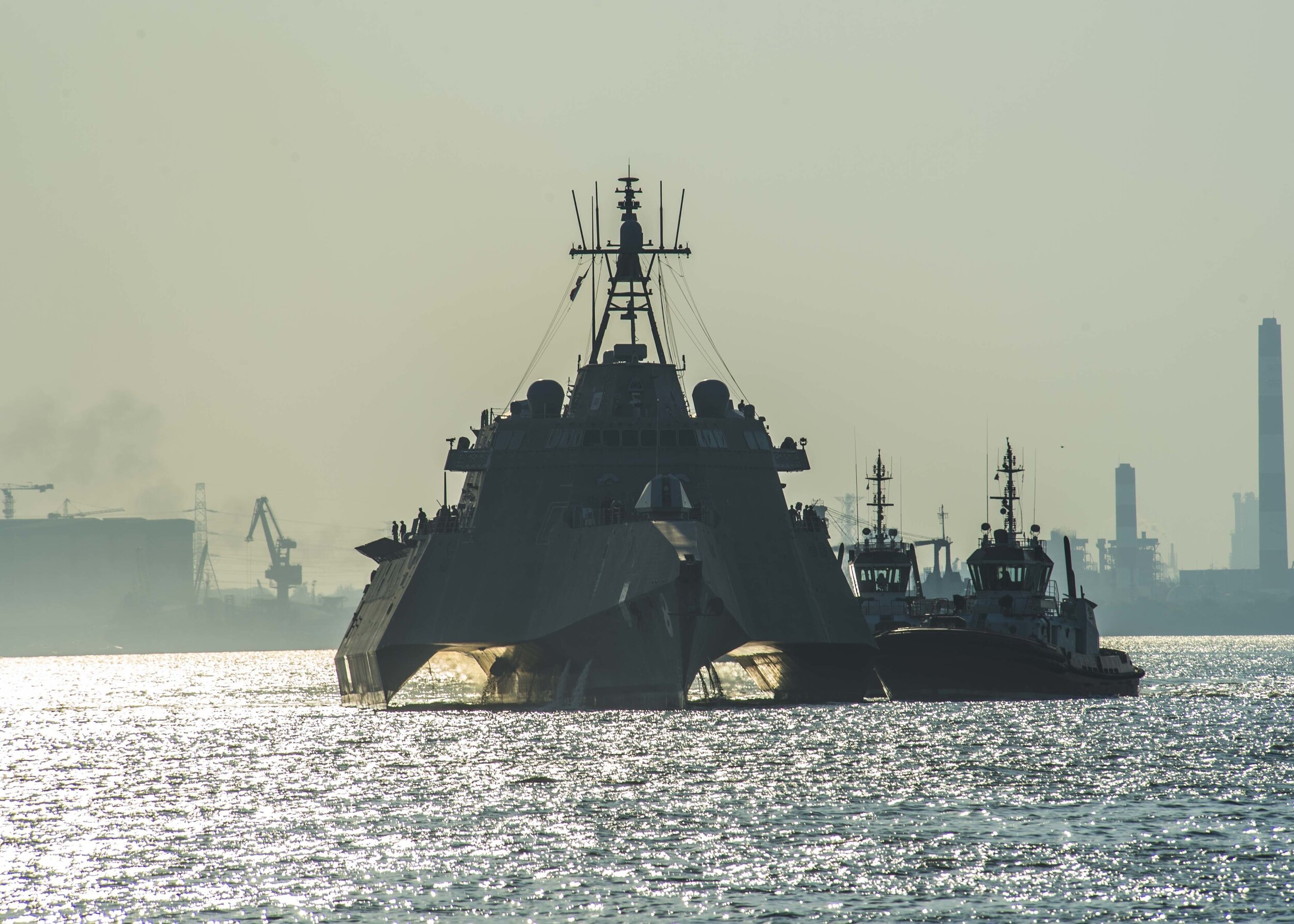
USS Gerald R. Ford (CVN-78) conducts high-speed turns in the Atlantic Ocean on Oct. 29, 2019. US Navy Photo

Unmanned Vehicle Operations, Global LCS Support Informed by Ongoing Wargaming, Prototyping

By: Megan Eckstein

November 21, 2019 11:38 AM

USNI.org

USS Indianapolis (LCS 17) sits pierside the evening before its commissioning ceremony. US Navy Photo

ARLINGTON, Va. – The Navy is conducting wargames and prototyping efforts to better understand how unmanned surface vehicles will fit into the fleet and how the Littoral Combat Ship will expand its presence around the globe.

Program Executive Officer for Unmanned and Small Combatants Rear Adm. Casey Moton this week described several efforts that look at how to maintain and sustain both types of vessels, as well as how USVs will operate and contribute to a fight alongside manned counterparts.

On the unmanned side, the Navy already has at its disposal two Large USVs as part of the Pentagon’s Overlord program that took vessels and converted them to autonomous controls. These first two Overlord vehicles contributed to Phase 1 testing, ensuring the vessels could navigate autonomously while following the rules of the road while at sea and also testing their hull, mechanical and electrical (HM&E) systems were reliable enough to support operations at sea without a maintenance team on hand at all times, Moton said Wednesday at a Surface Navy Association chapter lunch.

The Navy expects to buy two more Overlord vehicles this fiscal year, which will contribute – along with the first two vessels – to Phase 2 testing for more advanced work on navigation and HM&E reliability, as well as work with Navy payloads and command and controls systems.

Some things about LUSV are already known. For example, autonomy efforts will focus on navigation, obstacle avoidance, interactions with other ships at sea and keeping HM&E systems operating. LUSV will not have the autonomy to make decisions about firing missiles from its vertical launching system tubes.

“The plan is, human in the loop on these,” Moton said of decisions on weapons engagement. He said there’s been a lot of concern about fielding the LUSV, which essentially amounts of an unmanned missile truck. But, he noted, a manned Aegis destroyer can already be told to fire its weapons on a target the ship cannot see with its own sensors, and he said LUSV would operate in much the same way. A human will still make decisions on kinetic engagements, they just won’t be located on the vessel itself.

Other aspects of using USVs are less defined, though. Moton called today “a time of questions” on unmanned systems, and he said prototyping and experimentation was the only way to get through this time and move on to having answers.

For example, on tactics and CONOPS, Moton said the LUSV would be able to fire weapons as directed by other platforms, but it would not have its own sensors and fire control system and therefore the ability to fire weapons in self-defense. This means that the vessel would have to sail close to a destroyer, LCS or other ship that can provide protection, or be willing to be lost during a battle.

“They either operate close in with the protection of the units they’re supporting, or if you push them out further there’s an acknowledgement that you’ve either got to provide some over protection to them or you need to accept that a number of them are going to be attritable. And we are definitely tracking that,” Moton said.
“Some of what the N96 Future Surface Combatant Force [analysis of alternatives] has been doing is factoring those kinds of things in when they’ve done their scenario work” to figure out what capabilities the LUSV will need and how many the Navy will buy.

“Some of the tactics and CONOPS is part of what we’re working out with the Overlord,” Moton said. The Navy will continue to experiment with CONOPS once the Overlord vehicles and the subsequent Navy-designed LUSVs join the new Surface Development Squadron One.

Manning for the unmanned vehicle is another issue still being worked.

“At least initially … the LUSV requirements right now have a small crew onboard. And the desire of that is to support getting the ships underway from the pier and out the channel. Right now there’s going to be people onboard getting out to the sea buoys, doing things like force protection, refueling, personnel transfer, all those sorts of manpower-intensive things – people are going to be onboard. LUSV is actually going to be designed to accommodate those folks,” Moton said.
“At the right time, those folks can come off and it can be pushed out under autonomous operation to go do its mission. [Medium USV] is not going to actually have any bunks because it’s smaller, but it is going to have the capability for at least people to get onboard to get it in and out of port.”

Moton acknowledged there had been serious concern from lawmakers and others about the Navy’s understanding of how to operate unmanned vehicles and best leverage them into Navy operations. As a result, many lawmakers have supported cutting funding for LUSV and MUSV in the Fiscal Year 2020 budget, even as the Navy is trying to accelerate its unmanned investments to get to sea for experimentation and learning.

“Some of the great concerned reaction out there is, how are we going to answer these questions?” Moton said, noting questions remained on concepts of operations (CONOPS), logistics and sustainment, policy considerations, infrastructure and homeporting needs and more.
“We’re working on some of the answers. In terms of those big ones – how is it going to get out, how it’s going to do sea and anchor – we are being very measured about how we’re going to go do this.”

On the manned side, Moton addressed the LCS program, which now has three ships operating forward in two numbered fleets. USS Montgomery (LCS-8) and USS Gabrielle Giffords (LCS-10) are operating out of Singapore, and USS Detroit (LCS-7) is operating in U.S. 4th Fleet waters.

Montgomery and Giffords deploying from San Diego and operating forward in Singapore was always part of the plan; Detroit deploying from Mayport to 4th Fleet is a modification to the original vision, which would have had the East Coast ships heading to Bahrain in U.S. 5th Fleet.

Moton said the East Coast LCSs will eventually operate in U.S. 6th and 5th Fleets, but many questions remain as to how to support LCSs in these geographies.

Ahead of this first 4th Fleet deployment, “part of what we did was, we did quite a few tabletops looking at LCS corrective maintenance, preventative maintenance. We basically wargamed it – who was going to do what, where’s it going to happen out of, what kind of contracts. We did that working with 4th Fleet and with SEA 21,” he said, referring to Naval Sea Systems Command’s Ship Maintenance and Modernization arm.

Whereas, in that wargame, the PEO and SEA 21 partnered with the Southeast Regional Maintenance Center (SERMC) to learn how to support Detroit’s maiden deployment, for 6th and 5th Fleets the PEO and SEA 21 would partner with the Forward Deployed RMC, which has locations in Spain, Italy and Bahrain.

To supplement these wargaming efforts to better understand overseas maintenance and sustainment, Moton said lessons learned from the three ongoing deployments are being collected and disseminated by the Top Technical Issues forum he set up.

In collaboration with the Commander of Naval Surface Forces and Naval Supply Systems Command, the Top Technical Issues group is getting “almost real-time feedback from Montgomery and Gabrielle Giffords on where they need changes to their forward-deployed spares status, do we have the right contracting methods in place to reach back to [original equipment manufacturers], what are things we can do to make the ship operators and the RMCs more self-sufficient in their ability to do corrective maintenance? We are rolling all of those in as fast as we can, the lessons learned, and making improvements.”

Medium Displacement Unmanned Surface Vehicle (MDUSV) prototype Sea Hunter pulls into Joint Base Pearl Harbor-Hickam, Hawaii on Oct. 31, 2018. US Navy Photo

Medium Displacement Unmanned Surface Vehicle (MDUSV) prototype Sea Hunter pulls into Joint Base Pearl Harbor-Hickam, Hawaii on Oct. 31, 2018. US Navy Photo

USS Montgomery (LCS-8) arrives in the port of Tanjung Perak as part of Cooperation Afloat Readiness and Training (CARAT) Indonesia 2019 on July 31, 2019. US Navy Photo

USS Montgomery (LCS-8) arrives in the port of Tanjung Perak as part of Cooperation Afloat Readiness and Training (CARAT) Indonesia 2019 on July 31, 2019. US Navy Photo

Report to Congress on U.S. Navy Ship Names

November 20, 2019 9:33 AM • Updated: November 20, 2019 3:56 PM

USNI.org

The following is the Nov. 19, 2019 Congressional Research Service report, Navy Ship Names: Background for Congress.

From the report

Names for Navy ships traditionally have been chosen and announced by the Secretary of the Navy, under the direction of the President and in accordance with rules prescribed by Congress. Rules for giving certain types of names to certain types of Navy ships have evolved over time. There have been exceptions to the Navy’s ship-naming rules, particularly for the purpose of naming a ship for a person when the rule for that type of ship would have called for it to be named for something else. Some observers have perceived a breakdown in, or corruption of, the rules for naming Navy ships. On July 13, 2012, the Navy submitted to Congress a 73-page report on the Navy’s policies and practices for naming ships.

For ship types now being procured for the Navy, or recently procured for the Navy, naming rules can be summarized as follows:

  • The first Ohio replacement ballistic missile submarine (SSBN-826) has been named Columbia in honor of the District of Columbia, but the Navy has not stated what the naming rule for these ships will be.

  • Virginia (SSN-774) class attack submarines are being named for states.

  • Aircraft carriers are generally named for past U.S. Presidents. Of the past 14, 10 were named for past U.S. Presidents, and 2 for Members of Congress.

  • Destroyers are being named for deceased members of the Navy, Marine Corps, and Coast Guard, including Secretaries of the Navy.

  • The Navy has not yet announced a naming rule for its planned new class of FFG(X) frigates, the first of which the Navy wants to procure in FY2021. Previous classes of U.S. Navy frigates, like Navy destroyers, were generally named for naval leaders and heroes.

  • Littoral Combat Ships (LCSs) are being named for regionally important U.S. cities and communities.

  • Amphibious assault ships are being named for important battles in which U.S. Marines played a prominent part, and for famous earlier U.S. Navy ships that were not named for battles.

  • San Antonio (LPD-17) class amphibious ships are being named for major U.S. cities and communities, and cities and communities attacked on September 11, 2001.

  • John Lewis (TAO-205) class oilers are being named for people who fought for civil rights and human rights.

  • Expeditionary Fast Transports (EPFs) are being named for small U.S. cities.

  • Expeditionary Transport Docks (ESDs) and Expeditionary Sea Bases (ESBs) are being named for famous names or places of historical significance to U.S. Marines.

  • Navajo (TATS-6) class towing, salvage, and rescue ships are being named for prominent Native Americans or Native American tribes.

  • Since 1974, at least 21 U.S. military ships have been named for persons who were living at the time the name was announced. The most recent instance occurred on May 6, 2019, when the Navy announced that it was naming the destroyer [DDG-133] for former Senator Sam Nunn.

170701-N-N0101-023-2.jpg

Continuing Resolution Forcing Navy to Delay Ship Maintenance, Curtail Training

By: Megan Eckstein

November 15, 2019 4:32 PM

USS Detroit (LCS-7) receives regularly scheduled maintenance and upkeep during a scheduled dry-dock maintenance availability phase at BAE Systems shipyard in Jacksonville, Fla., March 29, 2019. US Navy Photo

THE PENTAGON – The Navy is already making hard decisions – curtailing training for air wings not imminently deploying, canceling planned ship maintenance availabilities – as the specter of a full-year continuing resolution looms.

Under continuing resolutions, the Navy is limited to the previous year’s spending levels for each budget line item, cannot increase the quantity of an acquisition program and cannot start a new program. The Navy also gets funding in smaller increments when short-term CR after short-term CRs are passed, instead of getting the full bucket of money upfront like they would under a regular appropriations bill.

Regardless of the previous year’s funding levels, the inflexibility to pursue the current year’s acquisition needs and instead being saddled with funding for the previous year’s priorities is always challenging.

But Fiscal Year 2019 was in many ways a high water mark for Navy spending on readiness enablers like maintenance, spare parts and training hours – and yet the Navy is looking at having to cancel as many as 14 ship maintenance availabilities and shutting down carrier air wings and expeditionary squadrons not heading into a deployment despite the relatively healthy budget the service would have under a full-year CR. Leadership says this is the only choice the Navy has amid so much fiscal uncertainty.

For example, in the ship maintenance account, the Navy requested $10.426 billion for ship depot maintenance in FY 2020 compared to $9.758 billion received in FY 2019, for a difference of $668 million or about a 6.4-percent reduction in funding the Navy would get for ship maintenance under a full-year CR. So why does this put 14 ships at risk for having their planned maintenance canceled?

Two top Navy civilian leaders say the contracts for these availabilities are the only “variable” costs within this line item, and therefore they are the only levers the Navy can control amid so much uncertainty about whether the service will get its full requested sum of money for the year or will see about a 10-percent decrease in spending levels under a full-year CR.

Similarly, on flight hours, the Navy has requested $5.682 billion in FY 2020 compared to the $5.712 billion given in FY 2019, meaning the service would actually have more money for flight hours than it needs; but it requested $2.284 billion for the related fleet air training account, compared to the $1.988 billion given in FY 2019, creating a 13-percent deficit in this enabler account. Despite the mixed bag on air operations spending under a CR, the Navy in a fact sheet released to Congress warns of shutting down non-deploying air wings and expeditionary squadrons and “restrict[ing] Fleet flying and steaming for training [and] deployments,” according to a fact sheet provided by the Navy.

Thomas Harker, the assistant secretary of the Navy for financial management and comptroller, told reporters today that, “at the line item level, we may have small incremental changes, things like [operations and maintenance], something like flight hours or ship depot maintenance: you may say, oh, well you’re not going to really be hurt that much because that’s not scheduled to increase that much (from FY 2019 to FY 2020). The problem is, you have to address these entire amounts across the fiscal year and look at how they affect a lot of our costs, and in many cases our costs are fixed. So we have things – civilian payroll, shipyard workers, they still need to get paid – so it’s the other things we can’t do. So the impact is greater because it’s the variable costs that have to pay for all the impact.”

James Geurts, the assistant secretary of the Navy for research, development and acquisition, added that, in the ship maintenance example, the service will pay for the infrastructure and personnel costs at the Navy’s four public shipyards first, for example, leaving less money available for the one variable cost: contracts awarded to private yards for maintenance and upgrades on destroyers, cruisers and amphibious ships.

Being unsure today whether Congress will enact a defense spending bill or if the Navy will be stuck with the CR that effectively trims the Navy’s spending by 10 percent compared to its requested levels, Geurts said, “when the fleet looks at all the things they’ve got to be able to do with the first increment of money they have, we say, well I don’t really want to move a ship availability to the right, but that’s my only option because I can’t get enough money to pay for all of that availability, and I can’t just start a week’s worth of it. And so they start making hard choices,” Geurts said.

This has already happened, even under this first short-term CR that expires next week. Maintenance contracts for Arleigh Burke-class guided-missile destroyers USS Bainbridge (DDG-96) and USS Gonzalez (DDG-66) were set to be awarded last week to private yards on the East Coast, but the Navy is choosing not to. This is partly because, after paying fixed costs, it doesn’t have the full sum of money to pay for the repair work. It is also partly a hedge against emergencies later in the year, if the CR stretches the full year; it is a desire to repair these ships now, but there could be a more pressing need for maintenance dollars later in the year if a ship set for deployment had an unexpected issue arise, and the Navy doesn’t want to be caught without the funds to respond.

“What’s frustrating me: one of the things you’ve heard when we talk ship maintenance is, hey, we want to get our planning set, we want to award the contract early; [Bainbridge] was one of them we had all set, we backed the planning up, had 120 days ready in advance, the team was ready to go, we had the materials all ready to go, and then suddenly, oh, we can’t do it now because we’re in a CR. The real challenge: we don’t know how long the next CR is, when [the contract] is going to get awarded.”

Geurts conceded that cutting 14 ship availabilities over a 6-percent funding cut to that line item may sound “more drastic” than is necessary, but he made clear “it’s because you’ve got to cover a lot of the fixed cost, and then the only thing to move around is some of these variable ones.”

The Navy has made a concerted effort to get maintenance on ships and aircraft done in a more timely manner, as massive backlogs at both public and private shipyards and at Navy aircraft depots has hurt fleet readiness in recent years. Better planning and new processes have been put in place already, USNI News has reported, but interruptions in cash flow and the ability to get contracts awarded on schedule will undo much of what the Navy has accomplished, officials fear.

Geurts said that, under a full-year CR, some of the 14 availabilities would be deferred and some would be canceled altogether if a ship was still operable without the maintenance period. That deferral of work – as the Navy has learned the hard way many times throughout its history – will ultimately cost more in the end to fix than it would if the scheduled maintenance was performed as planned.

If the Navy starts deferring this work this year, Geurts said, “then we get back into the condition we were in during sequestration where we were deferring maintenance. We’ve been working hard over the last two or three years to get all of our ships back onto their class maintenance plan, as opposed to deferring maintenance,” he said. Continuing to operate the ships after skipping the availabilities means “you have this installed liability that, eventually that bill comes to roost. And that’s been what we’ve been for the last two or three years trying to dig our way out of, and now we’ve picked up the shovels again and we’re digging.”

Harker said that, across the entire Navy budget, a “climate of scarcity” is already setting in, and offices are reluctant to spend money they typically would because they are unsure what the rest of the year will look like for them. Under a normal budget, the fiscal year is about 12 percent through already and so 12 percent of funds for flight hours and steaming hours, for example, would have already been used.

“Right now we’re significantly less than that because people are holding on, thinking, okay, I need to be more guarded with my resources,” Harker said.
“So you don’t see them making the investments. And then the impact on the training is, you look at the flight hours: okay, fleet commanders have to manage across their whole portfolios. So if they back away from executing things that are good to do but not critically necessary for the training for workups for someone who’s about to deploy, that gives them more flexibility to deal with potential casualties or engine problems” or other contingencies that may arise later in the year.

On the acquisition side, Geurts said the Navy did not plan any major contract awards for the first quarter of the year, as a hedge against short-term CRs. But if the CR stretches much longer, the service will have to ask for “anomalies,” or the authority to make an exception and start a new program or increase a procurement quantity despite the rules of a CR. Harker’s and Geurts’ offices are working on a list of anomalies they’d want to request if the CR stretches into the longer term.

For top-priority programs like the Columbia-class ballistic missile submarine, the Navy would certainly ask for an anomaly that is almost certain to be approved by the Secretary of Defense and then by Congress, since it is well recognized as among the most important acquisition programs in the Defense Department and is on a tight schedule as is.

But, Harker said, “a lot of the anomalies we would be asking for and the movements we would be asking for, they’re going to say, live with it. That’s the risk, and that’s what we’re fearful of. So how do we manage that? That’s why you see a lot of the different people that have funds out in the Navy and the Marine Corps executing carefully, because they worry, if I’m going to be stuck with this 10-percent cut, how am I going to absorb that?”

Geurts added that, “if we’re in a full-year CR with no anomaly approval and we’re 10 percent down on budget, we will fund Columbia; funding their 100-percent will mean that 10 percent of [Columbia’s] budget will come out of somewhere else.”

Under that worst-case scenario, Columbia funding would be preserved in full, as likely would be funding for the two-ship buy made last year for the Ford-class aircraft carrier and multiyear procurement contracts for must-haves like the Virginia-class submarine and Arleigh Burke-class destroyer. But the more programs the Navy protects, the greater the impact other programs would face, seeing well above a 10-percent cut in their funding or even being canceled altogether.

Geurts said he and Harker are looking closely at the entire portfolio to make the best decisions under the circumstance, to keep the Navy best on track to grow in size and readiness and to modernize.

“My fear of that is, we’re doing that, we’re not managing contracts. And so are companies,” Geurts said of all the time spent looking at how to mitigate the pain of a CR.
“So this uncertainty just takes attention away from executing the work as effectively and efficiently as we can.”

USS Mesa Verde (LPD-19) enters the basin to return pierside from a dry-docking pier on Jan. 25, 2019. US Navy Photo

USS Mesa Verde (LPD-19) enters the basin to return pierside from a dry-docking pier on Jan. 25, 2019. US Navy Photo

The portside anchor of the aircraft carrier USS George H.W. Bush (CVN-77) is lowered into a dry dock for maintenance. GHWB is currently in Norfolk Naval Shipyard, Va. US Navy Photo

The portside anchor of the aircraft carrier USS George H.W. Bush (CVN-77) is lowered into a dry dock for maintenance. GHWB is currently in Norfolk Naval Shipyard, Va. US Navy Photo

Artist’s rendering of the Columbia-class SSBN submarine. US Navy Image

Artist’s rendering of the Columbia-class SSBN submarine. US Navy Image

Achieving Digital Shipyard Success – ERP Holds the Key

BY KENNY INGRAM 2019-11-10 18:09:41

Maritime Executive

The emergence of the digital shipyard is an exciting prospect for major shipyards. By connecting workers, docks, tools and supply chains, the digital shipyard offers improved information sharing and substantial efficiencies over traditional shipbuilding environments. 

To ensure the viability of the product lifecycle management (PLM) solution in use, meet the unique requirements of the shipbuilding industry, and to manage every stage of a customer project to achieve profitability, the supporting enterprise resource planning (ERP) software must go beyond traditional ERP and PLM software. Kenny Ingram, Global Industry Director of Engineering, Construction, and Infrastructure at IFS, identifies the key areas that must be supported for digital shipyard success:

Proper PLM when building a huge vessel requires a unified approach to data across an operation, which means the system of record—ERP software—is the primary vehicle for PLM thinking. Best-of-Breed PLM software generally prioritizes computer-aided design (CAD) and 3D modeling, but product lifecycles go much further. PLM must be able to extend through manufacturing, fabrication, procurement, commissioning, overhaul, refit, maintenance, repair, and decommissioning. 

The digital shipyard needs a complete project and asset-centric ERP system that can support this broad vision and contain the master records for all data. This data can then be used to drive materials and component procurement, fabrication, employee hiring and the equipment rental required to complete a project. The data must then be available if a shipyard also extends maintenance repair and overhaul (MRO) services to its customers.

First – it starts with early stage data

In order to drive digital benefits across a shipbuilding operation, shipbuilders need more than PLM software. They must have a single software application that encompasses the key phases where they deliver value to their customers. This is challenging because of the project-centric nature of shipbuilding and some of the unique steps in the value chain including design and procurement.

ERP must start to address this process well before design commences, because deciding to pursue a contract, estimating and bidding are all complex, time-consuming and mission critical tasks. All information added to an enterprise application during these steps should flow into subsequent project phases to avoid duplicate work or poor communication as the process is handed back and forth between users of separate systems like CRM, PLM and manufacturing.

This early stage data must flow into the sales contract. The sales contract represents the starting point for the project and contains user requirements and subsequent steps to conform to, including specifications or functional mandates for the vessel and earned value management or progress-based billing. Enterprise software must encompass these steps or shipbuilders will be at a disadvantage from the start.
 
Next – instant communication of design changes is a necessity

Engineering and design of the vessel must be informed by these initial steps as a shipbuilder pursues and then secures a contract. Starting with the design process, contract management functionality in ERP is crucial because it ensures the delivery of agreed requirements. Because design is still somewhat of an iterative process, this means that any changes to the design must be communicated from the design tool through to other parties immediately. 

From the initial design stages, procurement may already be working on long lead time items that must be fabricated or engineered to order. As the design changes, specifications for these items may change, and procurement professionals will need to immediately revise active orders with suppliers and subcontractors. Without the tools for real-time communication of changes, these long lead time items may push the project schedule out in violation of contractual requirements. At the very least, out of pocket expenses will increase due to rework and rush fees.

After that – answer key financial & operational questions

Each shipbuilding project has two sides—financial management and operational work/management. Shipbuilding ERP must encompass both a cost breakdown structure and a work breakdown structure. The cost breakdown structure allows project costs and revenues to be broken down into a hierarchy where budgets or monthly forecasts can be managed at any level of the structure. In addition, project financial control needs to manage cash, contract/variation management, project accounting, risk and opportunity, and progress or milestone-based billing. The work breakdown structure is operational—it encompasses what is done at what point to ensure work is proceeding according to contractual requirements. 

Most shipbuilders today make heavy of use of Excel as they do not have a project centric ERP solution. This lack of integration hinders their journey towards digital shipyard status because there is no way to reconcile the work breakdown structure and the cost breakdown structure. Key questions like what project steps have been completed, how those steps correspond to project milestones and payment events and, ultimately, whether a project is on track to make or lose money cannot be reliably answered without fully integrated, project-driven shipbuilding ERP.

Finally – address projects across the enterprise

Shipbuilding ERP must bring together the operational and financial sides of the project to help shipbuilders track estimate to complete (ETC) by hours, which provides a forecasted number of hours and dollars to complete the project. The ERP should also help with estimate at completion (EAC) by hours which provides a forecast cost of the project at completion.

To deliver visibility into ETC and EAC, however, ERP must encompass the contract itself, project management and different cost drivers. These cost drivers include materials procurement, equipment rental and chargeable use of internal equipment, subcontractors and employee hours consumed against the project.

In order to meet the contractual obligations and satisfy the customer reliably, the different logistical elements that underpin successful project delivery must also be covered by ERP. Shipbuilders need strong inventory functionality to ensure that stockouts do not push milestones past timelines, which impacts revenue and the customer experience. 

Equipment availability and readiness is also critical to a shipbuilder’s ability to deliver. ERP must address maintenance and reliability of owned equipment such as gantry cranes, robotic and manual welders and even the dry docks themselves. Many shipyards are running equipment that on paper has exceeded its useful life, so embedded enterprise asset management (EAM) and maintenance capabilities are crucial.

The market is changing and so should shipbuilders

Shipbuilders can see the benefits, but in order to adapt to change they need ERP systems that will help them. These changes may center around the technology they use on a project, but more and more it is the technology embedded in the projects they complete for customers that is evolving faster.

Vessels are becoming more complex and are likely to include IoT elements designed to drive condition-based, preventive and predictive maintenance. This means a shipbuilder will be required to consider how to use data from sensors as part of an asset lifecycle service program. Over the lifecycle of the vessel, data from IoT and changes made to specifications during maintenance and refits should be added to a digital twin of the asset, so the owner has full information that helps them get the most out of their investment.

Industry vendors such as Rolls-Royce, General Electric and Honeywell—and customers like the U.S. Navy—are also working towards a goal of autonomous surface ships, which are expected to become viable by 2028. IBM claims a smart port, fitted with cloud and IoT capabilities, will be ready to host autonomous ships by 2025. 

Don’t forget – adapt to new technology & rise to greater competition

Shipbuilders will need to deal with increased competition. Vessels such as bulk carriers are built increasingly in Southeast Asia. Middle Eastern countries are producing tanker ships as they seek to pull more of the capital projects associated with petroleum back within their borders. 

But product categories such as cruise liners are seeing a lot of activity. It is these vessels, which require extensive consumer insight, innovation and new amenities, where higher-wage countries including Italy, Germany, Norway and the U.S. may see the most opportunity. 

ERP software should enable shipbuilders to confidently manage increasingly complex customer projects, meet customer requirements for billing and project control, and meet the demands that come with advancing technology and economic trends. The right shipbuilding ERP will help shipbuilders identify the best revenue opportunities, make go or no-go decisions about pursuing projects and compete depending on innovation and quality, rather than price.
 

181215-N-N0101-113.jpg

ExMCM Companies, LCS Mission Package Will Both Contribute to New Mine Countermeasures Triad

By: Megan Eckstein

November 6, 2019 1:32 PM

Operations Specialist First Class Sean McNamara launches the Mk 18 Mod 2 Kingfish for an initial underwater survey of Sweeper Cove on Adak Island in the Alaska’s Aleutian chain. EODMU 1 is providing expeditionary mine countermeasures support in support of Arctic Expeditionary Capabilities Exercise 2019. EODMU 1 provides operational EOD capabilities to include locating, identifying, rendering safe, exploiting, recovering, and disposing of all explosive ordnance. US Navy photo.

The Navy had previously meant to replace its legacy mine countermeasures triad of helicopters, wooden-hull ships and divers with a Littoral Combat Ship mission package that could mostly do it all with unmanned systems – but unexpected success with a separate family of systems is leading to a new triad of capabilities for fleet commanders to employ.

The LCS mission package was envisioned to replace the Avenger-class MCM ships and the MH-53E helicopter. The mission package would have unmanned aerial, surface and underwater vehicles that would be outfitted with sweeps, sensors and neutralizers, so they could conduct the full range of detect-to-engage mine countermeasures while minimizing or eliminating the need for a human in the mine field.

While that technology was in development, though, the Navy began using the Mk 18 Mod 1 Swordfish and the Mk 18 Mod 2 Kingfish family of systems in its explosive ordnance disposal units as a bridge, until the LCS unmanned systems could be fielded. But their greater-than-expected success and relatively low cost have helped carve out a more permanent place in the fleet for these vehicles.

Today, the Expeditionary Mine Countermeasures (ExMCM) companies include an unmanned systems platoon to launch and recover these unmanned underwater vehicles from an 11-meter rigid-hull inflatable boat; a post-mission analysis cell to analyze sonar and video data; and an EOD MCM platoon with divers who could reacquire a threat, neutralize it, or remove it from the water for further study.

“ExMCM was meant to be a bridging solution. Turned out to be a very viable, capable system that we’ve now decided is going to be an enduring system. Currently it’s only deployed in 5th Fleet, but we are purchasing additional ExMCM for 7th Fleet and perhaps even for 6th Fleet,” Capt. Chris Merwin, the director for mine warfare at the Naval Surface and Mine Warfighting Development Center, said at a recent National Defense Industrial Association event.

Merwin added that the timing of buying these systems and fielding them in European and Pacific waters would depend on budgets, but he was clear that that’s the direction the Navy wants to move in.

“Not designed for large area search, per se, but certainly for very specific smaller area searches, Q routes – very capable when you’re talking supporting Marines for amphibious assault, very good in-shore capabilities,” he said.
“No real down side to them except for they do need – very very capable, very flexible, it can operate from virtually any platform you want to put it on, but it does require a vessel of opportunity. So I don’t want to say there’s no investment that’s got to be made; you either operate it from a shore, which of course could be helpful but could limit where you could take it, or you need to put it on a vessel.”

Merwin made clear that the new support for the ExMCM companies and their capability will not take away from support for the LCS and its mission package.

“I think it’s just, more is better. It was a very proven, high [operational availability] technology. Very relatively inexpensive technology. I don’t have the numbers in front of me, but it is a fraction, an ExMCM company costs a fraction of what an LCS mission package costs. And they are not the same, they certainly, each has their strengths and they each have weaknesses, but they work really well together,” Merwin told USNI News when asked if the decision to expand the ExMCM presence to 6th and 7th fleets says anything about the LCS and its capabilities.

“So I think it was, once we got the systems and tested them in 5th Fleet, it became a no-brainer that this was a very capable system” that would prove useful to operators, Merwin continued.
“It’s highly mobile, it’s airmobile – I can have an ExMCM company strat-lifted anywhere in the world I needed to in 24 to 48 hours, and nothing else can do that. I don’t think that says anything negative about the LCS – so they each have a place, they each have a role. It’s a team effort, just like the current legacy triad.”

Asked after his speech if the concepts of operations for mine warfare had ExMCM companies and LCS ships used separately for different types of contingencies or in a collaborative manner, Merwin said, “the intent is definitely to work them together. They certainly each bring their own strengths and their own weaknesses, and it’s up to the MCM commander to decide which one he’s going to apply for which area. But they’re meant to work together. It’s absolutely a team effort, and it’s proven itself time and time again to work well when we do that.”

Even as the ExMCM company presence is set to expand, so too is the LCS mission package. Merwin said the Navy is buying 24 mission package sets but will only have 15 ship hulls dedicated to the mine countermeasures mission. Rather than keep the nine remaining packages on the shelf as spare parts, the Navy is actively looking at what other kinds of ships could serve as a vessel of opportunity to host the MCM unmanned vehicles and crews if needed.

The Navy has already loaded its MCM unmanned vehicles onto the British Mounts Bay-class ships and the USNS Hershel “Woody Williams (T-ESB-4) to ensure the ships had physical space as well as power and command and control capabilities to support MCM mission package operations, Merwin noted. He added that the San Antonio-class amphibious transport dock hadn’t yet conducted testing with the mission package but would likely be a good fit due to having so much space for embarked forces.

“The Navy is in the middle of testing these other vessels of opportunity – what are the things we need to learn, the [tactics, techniques and procedures] we need to develop, things we need to have ready before we were to embark it on another ship. That’s where we’re going; it’s definitely going to be modular, it’s definitely going to be able to put on any platform it needs to be put on, but it is built around the LCS,” Merwin said, making clear that the 15 LCS ships slated for MCM operations would continue to focus on that mission set despite the success of loading the mission package onto VOOs.

U.S. Navy Chief Aerographer’s Mate Travis Lawson and U.S. Navy Mineman 2nd Class Mathew Williams, both assigned to the Explosive Ordnance Disposal Mobile Unit (EODMU) 5 Unmanned Systems (UMS) Platoon 141, lower an Mark 18 MOD 1 Swordfish unmanned un…

U.S. Navy Chief Aerographer’s Mate Travis Lawson and U.S. Navy Mineman 2nd Class Mathew Williams, both assigned to the Explosive Ordnance Disposal Mobile Unit (EODMU) 5 Unmanned Systems (UMS) Platoon 141, lower an Mark 18 MOD 1 Swordfish unmanned underwater vehicle (UUV) into the water as members of the Indonesian Navy’s Komando Pasukan Katak (KOPASKA) 2nd Fleet Surabaya Unit observe during a UUV familiarization drill as part of a mine countermeasures knowledge exchange for Cooperation Afloat Readiness and Training (CARAT) Indonesia 2019. US Navy photo.

Sailors and civil service mariners assigned to Military Sealift Command’s expeditionary sea base, USNS Hershel “Woody” Williams (T-ESB 4), launch an unmanned underwater vehicle (UUV) Knightfish while at anchor in the Chesapeake Bay, Sept. 14, 2019. …

Sailors and civil service mariners assigned to Military Sealift Command’s expeditionary sea base, USNS Hershel “Woody” Williams (T-ESB 4), launch an unmanned underwater vehicle (UUV) Knightfish while at anchor in the Chesapeake Bay, Sept. 14, 2019. Knightfish is a mine counter measure platform and the evolution was the first time a UUV was launched and recovered by an expeditionary sea base. US Navy photo.

Report to Congress on Navy Force Structure

Report to Congress on Navy Force Structure

November 6, 2019 8:48 AM

The following is the Nov. 1, 2019 Congressional Research Service report, Navy Force Structure and Shipbuilding Plans: Background and Issues for Congress.

From the report

The current and planned size and composition of the Navy, the rate of Navy ship procurement, and the prospective affordability of the Navy’s shipbuilding plans have been oversight matters for the congressional defense committees for many years.

On December 15, 2016, the Navy released a force-structure goal that calls for achieving and maintaining a fleet of 355 ships of certain types and numbers. The 355-ship force-level goal is the result of a Force Structure Assessment (FSA) conducted by the Navy in 2016. The Navy states that a new FSA is now underway as the successor to the 2016 FSA. This new FSA, Navy officials state, is to be completed by the end of 2019.

Navy and Marine Corps officials have suggested in their public remarks that this new FSA could change not only the 355-ship figure, but even more fundamentally, the fleet’s architecture, meaning the fleet’s basic mix of ship and aircraft types. Some observers, viewing statements by Navy officials, believe the new FSA might shift the Navy’s surface force to a more distributed architecture that includes a reduced proportion of large surface combatants (i.e., cruisers and destroyers), an increased proportion of small surface combatants (i.e., frigates and LCSs), and a newly created third tier of unmanned surface vehicles (USVs). Statements from the Commandant of the Marine Corps suggest that the new FSA might change the Navy’s amphibious ship force to an architecture based on a new amphibious lift target and a new mix of amphibious ships. Some observers believe the new FSA might also change the Navy’s undersea force to a more distributed architecture that includes, in addition to attack submarines (SSNs) and bottom-based sensors, a new element of extra-large unmanned underwater vehicles (XLUUVs), which might be thought of as unmanned submarines.

The Navy’s proposed FY2020 budget requests funding for the procurement of 12 new ships, including one Gerald R. Ford (CVN-78) class aircraft carrier, three Virginia-class attack submarines, three DDG-51 class Aegis destroyers, one FFG(X) frigate, two John Lewis (TAO-205) class oilers, and two TATS towing, salvage, and rescue ships. The Navy’s FY2020 five-year (FY2020-FY2024) shipbuilding plan includes 55 new ships, or an average of 11 new ships per year.

The Navy’s FY2020 30-year (FY2020-FY2049) shipbuilding plan includes 304 ships, or an average of about 10 per year. If the FY2020 30-year shipbuilding plan is implemented, the Navy projects that it will achieve a total of 355 ships by FY2034. This is about 20 years sooner than projected under the Navy’s FY2019 30-year shipbuilding plan—an acceleration primarily due to a decision announced by the Navy in April 2018, after the FY2019 plan was submitted, to increase the service lives of all DDG-51 destroyers to 45 years. Although the Navy projects that the fleet will reach a total of 355 ships in FY2034, the Navy in that year and subsequent years will not match the composition called for in the FY2016 FSA.

One issue for Congress is whether the new FSA that the Navy is conducting will change the 355-ship force-level objective established by the 2016 FSA and, if so, in what ways. Another issue for Congress concerns the prospective affordability of the Navy’s 30-year shipbuilding plan. Another issue for Congress concerns the potential impacts on FY2020 Navy shipbuilding programs of using one or more continuing resolutions to fund DOD operations for at least some portion of FY2020. Decisions that Congress makes regarding Navy force structure and shipbuilding plans can substantially affect Navy capabilities and funding requirements and the U.S. shipbuilding industrial base.

a21599005f05a8fff18ca9790444b4cc.jpg

VIDEO: USS Detroit Departs for Maiden Deployment to SOUTHCOM

By: Megan Eckstein

November 4, 2019 12:23 PM

The Freedom-variant littoral combat ship USS Detroit (LCS 7) departs Naval Station Mayport for a scheduled deployment. Detroit is deployed in support of Campaign Martillo, a joint operation with the U.S. Coast Guard and partner nations, within the U.S. 4th Fleet area of operations. US Navy photo.

Freedom-class Littoral Combat Ship USS Detroit (LCS-7) departed Mayport, Fla., last week on its maiden deployment and the first deployment from the East Coast since a LCS community reorganization.

Detroit, which departed on Oct. 31, will operate in the U.S. Southern Command area of responsibility. The deployment will include operations in support of Joint Interagency Task Force South’s Campaign MARTILLO, a multinational effort that dates back to January 2012 and targets illicit trafficking routes in coastal waters along Central America.

“I expect this deployment to offer a great opportunity to work together with regional partners throughout Southern Command Area of Responsibility,” Capt. Cory Applebee, the commander of Surface Warfare Division 21 in Mayport, said in a Navy news release.

In 2016 the Navy reorganized its LCS fleet. The first four ships, which were built slightly differently, would be used as test ships in San Diego. Beginning with the fifth hull, all Independence-variant LCSs would be homeported in San Diego and all Freedom-variant LCSs would be homeported in Mayport. Both hubs would form divisions that focus on surface warfare, mine countermeasures or anti-submarine warfare as their sole warfare area.

This summer, the Navy deployed USS Montgomery (LCS-8) and USS Gabrielle Giffords (LCS-10) to Singapore out of San Diego, in the first LCS deployments since that reorganization. Detroit’s deployment is the first from the East Coast since the reorganization.

The Navy had previously intended the East Coast LCSs to deploy to Bahrain. However, those plans have evolved over the past several years, partly due to the ship’s capabilities and partly due to the theaters’ ability to support the ships on deployment. For now, Mayport-based ships will deploy to SOUTHCOM and U.S. 4th Fleet, though that could eventually change to Bahrain and U.S. 5th Fleet, or even European waters in U.S. 6th Fleet.

Prior to the LCS reorganization, USS Freedom (LCS-1) deployed to SOUTHCOM in 2010 to conduct counter-illicit trafficking and partner-building activities. The ship’s shallow draft and high speed were viewed as assets in running down vessels conducting trafficking. Since that time, the LCSs have brought on additional capabilities that will aid in that mission. According to the Navy news release, Detroit deployed with a U.S. Coast Guard law enforcement detachment and an aviation detachment to operate an embarked MH-60S Seahawk helicopter and two MQ-8B Fire Scout Vertical Takeoff Unmanned Vehicles.

Detroit is currently manned by its Gold Crew, which will swap out with the Blue Crew every four to five months, in a model meant to maximize the amount of time the hull itself can spend operating forward.

Campaign Martillo includes 20 partner nations working together to target illicit trafficking routes.

“We hope Detroit will build relationships with that region and show that LCS is a capable warfighting platform that is ready to safeguard access to international waterways and demonstrate operating capabilities,” Applebee said.

The Freedom-variant littoral combat ship USS Detroit (LCS 7) departs Naval Station Mayport for a scheduled deployment. US Navy photo.

The Freedom-variant littoral combat ship USS Detroit (LCS 7) departs Naval Station Mayport for a scheduled deployment. US Navy photo.

Heritage Index Rates Navy, Marines ‘Marginal’ In Ability to Counter Current Threats

By: John Grady

October 30, 2019 8:01 PM

U.S. Marines with Combat Logistics Battalion (CLB) 8, Combat Logistics Regiment 2, 2nd Marine Logistics Group, carry simulated casualties to a MV-22 Osprey during motorized operations course as part Integrated Training Exercise (ITX) 1-20 on Marine Corps Air Ground Combat Center Twentynine Palms, Calif., Oct. 6, 2019. US Marine Corps Photo

The Navy and the Marine Corps have been assessed as “marginal” in their ability to meet the challenges from rival powers in Beijing and Moscow, as well as regional threats coming from Tehran and Pyongyang, according to annual report on U.S. military strength from The Heritage Foundation.

The rating for the Marine Corps was an improvement over last year’s assessment of “weak” as part of the 2020 Index of U.S. Military Strength. That rating and the sea services’ commitment to improving readiness across the board were among the few examples in the Defense Department of improvement from last year’s assessment.

The annual assessment weighs military strength and the operating environment American forces would most likely operate in: Europe, Asia and Middle East. There are five tiers to assessing the strength: very strong, strong, marginal, weak, very weak.

“We think we have a one-war force” in explaining how the index judged the strength of the individual services and Pentagon capabilities, like nuclear deterrence, against what would be required to meet the requirements to successfully engage in two major regional conflicts almost simultaneously, Dakota Wood, a senior fellow at Heritage, said on Wednesday. Not included in the Index are logistics, medical support, etc.

“We look at hard combat power,” Wood said.

Describing the overall picture of American military strength as “marginal,” Wood said,
“we chose that word intentionally” in assessing the United States had the capacity and capability to meeting the Pentagon’s former stated goal of having enough forces to sustain two wars simultaneously.

The 2018 National Defense Strategy does not address the possibility of two major regional conflicts at the same time, the co-chairmen of a commission assigned to review it told Congress.

“Budget constraints are a big deal” and they have an effect on what can be done now and future including DoD investments in artificial intelligence, advanced manufacturing, hypersonic weapons and other future technologies.

“Modern technologies are kind of a leveler,” he said, noting that $13-billion aircraft carriers remain vulnerable to anti-ship cruise missiles that cost a bare fraction of the vessels. “Our competitors have really been muscling up.”

The report this year discusses the need to increase the number of Marine infantry battalions above 24 to “the mid-30s” to reduce the pressure of constant deployments with little time at home for Marines, he added. It would also mean the “almost exclusive focus on the Indo-Pacific” of the Marine Corps’ current posture could be adjusted to address conflicts in other regions, read the report.

“Despite an increase in manpower, the Corps continues to operate with less than 67 percent of the number of battalions relative to the two major regional conflict benchmark,” read the report. Based on that decficit, Hertitage scored Marine Corps capacity as “weak.” The authors noted that to meet the needs of Operation Iraqi Freedom, 66,000 Marines were deployed to that mission. In addition, about 27,000 more Marine were assigned to the region at the time.

More battalions also can translate into a “ready bench,” in the report’s phrase, to a host of contingencies that are not directly connected competition with China and Russia.

For the Marines, Wood said the importance of “adjusting ship architecture” with the Navy over what kind of vessels will be needed in the future cannot be overlooked.

Marine aviation, “has been particularly stressed by insufficient funding” noticeable in troubling readiness rates of its F/A-18 squadrons. While introducing “the F-35 platform into the fleet … the F/A 18 Hornets remain ‘the primary bridging platform’ [to that end and] will remain the force until 2030.”

The U.S. Navy’s fleet size is a concern to meeting the challenges posed from the Chinese with the Peoples Liberation Army-Navy at 300 ships and the China Coast Guard at 175.

The report envisions a 400-ship fleet to meet the Navy’s existing global requirements, but recent statements from service leaders indicate that a 355-ship fleet may become a “nice target” as the goal is outside the range of affordability with current ship budgets.

Following two deadly collisions in 2017, Wood said, “the Navy has gotten serious on training sailors” on their seamanship skills and that is reflected in the assessment. “But it will be several years before they can fully change the culture and raise the level of the fleet’s overall professional knowledge and experience,” he said.

The report also noted the impact of so much delayed maintenance on a fleet that is “used harder and is aging,” Wood noted. He said 57 percent of the American fleet is 20 years old or older; and the newer ships tend to be smaller vessels, such as the Littoral Combat Ships. The report said without the necessary increased and sustained funding to meet recapitalization requirements and “improvements in shipyard maintenance capacity, the readiness of the Navy’s fleet will remain compromised.”

The impact of all this creates “a kind of death spiral” of readiness, especially among heavier vessels like aircraft carriers and cruisers for surface vessels. The delay and time in shipyards for needed repairs “are very problematic.”

The Navy needs “about a 30 percent increase in their shipbuilding accounts” to account for the impact of developing and building the Columbia class ballistic missile submarine and the Ford class aircraft carrier that would allow other classes of ships to be designed or modernized.

“There are warning clouds of the horizon,” he said about the shipbuilding accounts. The study said the limits on the shipbuilding accounts even with the current budget agreement for the next two fiscal years “will make it extremely difficult for the Navy to increase capacity and field new lethal capabilities in the near term.”

The guided-missile destroyer USS Bainbridge (DDG 96) sails in the Arabian Sea. Bainbridge is deployed to the U.S. 5th Fleet area of operations in support of naval operations to ensure maritime stability and security in the Central Region. US Navy ph…

The guided-missile destroyer USS Bainbridge (DDG 96) sails in the Arabian Sea. Bainbridge is deployed to the U.S. 5th Fleet area of operations in support of naval operations to ensure maritime stability and security in the Central Region. US Navy photo.

Heritage Foundation Image

Heritage Foundation Image

aging-life-expectancy-1.jpg

Admiral: Navy Can Afford to Field a 310-Ship Fleet, Not 355

By: Ben Werner

October 28, 2019 1:37 PM • Updated: October 29, 2019 6:33 AM

A loved one watches as the guided-missile destroyer USS Gonzalez (DDG 66) departs Naval Station Norfolk on March 15, 2019. US Navy Photo

ARLINGTON, Va. – The Navy is unlikely to field a 355-ship fleet in the near- or even mid-term future if funding doesn’t change dramatically, the department’s top leadership said during a pair of appearances last week.

The 355-ship Navy is a nice target; however, ship readiness is more critical for the service as it plans how the fleet will look in the future, Vice Chief of Naval Operations Adm. Robert Burke said Friday while speaking with reporters at the Military Reporters and Editors conference.

“Will we get to 355-ships?” Burke said. “I think with today’s fiscal situation, where the Navy’s top line is right now, we can keep around 305 to 310 ships whole, properly manned, properly maintained, properly equipped, and properly ready.”

The Department of the Navy requested $205.6 billion for Fiscal Year 2020 and focused spending on fielding new capabilities and canceling some modernization and life-extension efforts. The budget request outlined a path to fielding a 314-ship fleet by 2024, which was a decrease from the FY 2019 budget request’s plan to reach 326 ships by 2023. Congress has not passed an FY 2020 budget.

The target of a 355-ship fleet was announced in 2016, based on a force structure assessment the Navy released at the time. However, Navy leaders have since walked back from saying fielding 355-ship fleet was etched in stone; former Chief of Naval Operations Adm. John Richardson in early 2018 began foot-stomping the idea of a whole Navy, where the size of the fleet was only one of six components that needed to be considered. Congress, on the other hand, codified the 355-ship Navy into law.

A Congressional Budget Office report states Navy leadership started alerting Congress that the 355-ship fleet target was likely to change when a new force structure assessment is completed by the end of this year. However, even though the ship total goal may change, the projected funds for the Navy in the future puts a practical cap on what the Navy can build and sustain, Burke said.

“If our top line does not go up, if it remains where it is now and is projected to remain in the future defense plans, that’s about where we can get to and do it right, in terms of man those ships and maintain them and have all the ordnance for them and generate readiness,” Burke said. “We would need an increased top line.”

Secretary of the Navy Richard V. Spencer, during an appearance at the Brookings Institution last week, also confirmed the future fleet would likely be smaller than the 2016 force structure assessment recommends.

“A 355-ship Navy is an important aspirational goal,” Spencer said. “But more important is ensuring that we have the maximum capability to address every challenge we’re going to be facing.”

180830-N-EA818-1173.jpg