Navy Accelerating Contracts to Get Ahead of Upcoming Work to Address COVID-Related Program Disruptions

By: Megan Eckstein

April 1, 2020 1:00 PM • Updated: April 1, 2020 11:12 PM

USNI.org

A worker in the shipyard’s foundry uses a torch to slice through scrap steel at Newport News Shipbuilding. HII Photo

This post has been updated to clarify comments from James Geurts and add that, while the Navy expects an increased number of contract actions this summer to keep programs on track despite coronavirus-related delays, it’s unclear how much that effort will cost and how it will be paid for.

The Navy’s acquisition community is seeking to move work ahead of schedule and find as many efficiencies as possible, ahead of what could be a mountain of work to adjust contracts and try to keep programs on track once the effects of the COVID-19 pandemic are more fully understood, the Navy’s top acquisition official said today.

James Geurts said in a media roundtable today that, on top of their normal workload, his staff and program managers across the Navy would have to undertake “extra work sorting out all of these programs and contracts … this summer. So we are driving efficiency to create the bandwidth we’re going to need, because there will be a fairly major effort this summer ensuring that we can fairly and reasonably adjust the programs based on the impacts we’re seeing here.”

The assistant secretary of the Navy for research, development and acquisition said it was too early to tell exactly how many contract actions might be needed this summer to correct all the delays, contract breaches and other issues that may arise during the pandemic, but he did say that “the services side of business I don’t think will be as drastic an impact as perhaps some of the major industrial operations. But we’re going to have to work our way through it. That’s why it was important for me … to baseline the programs and then we can more quickly sort out where do we need to make adjustments as we go forward.”

Last week he told reporters that his staff had baselined each Navy acquisition program to understand its current state of performance, so that any future delays could be determined to be resulting from the pandemic or not.

Geurts’ spokesman, Capt. Danny Hernandez, told USNI News after the roundtable that an assessment of the potential funding shortfalls related to the coronavirus is ongoing, and that the Navy and the Office of the Secretary of Defense were having ongoing talks about how those shortfalls might be paid for.

Where he can stave off potential program delays and disruptions, he’s looking to take action now to do so. A key action the Navy acquisition community has been focused on is awarding work early where possible, to create a healthy backlog of work for even the smallest suppliers, so no one finds themselves with a healthy workforce but no work to tackle.

Geurts said he had already awarded contracts for the AIM-9X Sidewinder air-to-air missile to Raytheon, the Near Coast Patrol Vessel to Metal Shark, the Navajo-class T-ATS tug to Gulf Island and a berthing barge to VT Halter. In the near future, contracts will be awarded for amphibious transport dock LPD-31 to Ingalls Shipbuilding and for Landing Craft Utilities to Swiftships – with many of these contract awards coming several months ahead of schedule to keep cash and work flowing.

“I hear stories of second-, third- and fourth-tier suppliers that were worried about going out of business, worried about how they would keep paying their salaries, and our ability to move and accelerate work into the defense base and then have that be pushed out to the suppliers is absolutely critical, because if they’re not there it won’t matter when we’re ready to recover,” Geurts said.
“We need to make sure they’re healthy and ready to roll as we accelerate out of recovery.”

In the past couple weeks alone, major shipyards have pushed hundreds of millions of dollars of work out into the supply base. Geurts said this was important during the pandemic because not all cities will be hit by the virus at the same time. With the disease potentially crippling different workforces at different times this year, “as individual suppliers and industrial operations deal with their local situation, they can do it knowing they’ve got work ready to go and then as soon as they’re ready to go at their capacity, that work will be with them.”

At the program level, he said, this ability for lower-tier suppliers to forge ahead when and as they’re able to will “enable us to create some resiliency in near-term delay and disruption, as well as enable us to accelerate recovery” and try to get programs back on track later on.

5-DCS19-712-33.jpg

Report to Congress on Navy Force Structure

March 26, 2020 8:18 AM

The following is the March 25, 2020 Congressional Research Service report, Navy Force Structure and Shipbuilding Plans: Background and Issues for Congress.

From the report

In December 2016, the Navy released a force-structure goal that calls for achieving and maintaining a fleet of 355 ships of certain types and numbers. The 355-ship goal was made U.S. policy by Section 1025 of the FY2018 National Defense Authorization Act (H.R. 2810/P.L. 115-91 of December 12, 2017). The Trump Administration has identified the achievement of a Navy of 355 or more ships within 10 years as a high priority. The Navy states that it is working as well as it can, within a Navy budget top line that is essentially flat in real (i.e., inflation-adjusted terms), toward achieving that goal while also adequately funding other Navy priorities, such as restoring eroded ship readiness and improving fleet lethality. Navy officials state that while the 355-ship goal is a priority, they want to avoid creating a so-called hollow force, meaning a Navy that has an adequate number of ships but is unable to properly crew, arm, operate, and maintain those ships.

The Navy states that its proposed FY2021 budget requests the procurement of eight new ships, but this figure includes LPD-31, an LPD-17 Flight II amphibious ship that Congress procured (i.e., authorized and appropriated procurement funding for) in FY2020. Excluding this ship, the Navy’s proposed FY2021 budget requests the procurement of seven new ships rather than eight.

A figure of 7 new ships is less than the 11 that the Navy requested for FY2020 (a figure that excludes CVN-81, an aircraft carrier that Congress authorized in FY2019) or the 13 that Congress procured in FY2020 (a figure that again excludes CVN-81, but includes the above-mentioned LPD-31 as well as an LHA amphibious assault ship that Congress also procured in FY2020). The figure of 7 new ships is also less than the 10 ships that the Navy projected under its FY2020 budget submission that it would request for FY2021, and less than the average ship procurement rate that would be needed over the long run, given current ship service lives, to achieve and maintain a 355-ship fleet.

In dollar terms, the Navy is requesting a total of about $19.9 billion for its shipbuilding account for FY2021. This is about $3.9 billion (16.3 %) less than the Navy requested for the account for FY2020, about $4.1 billion (17.0%) less than Congress provided for the account for FY2020, and about $3.6 billion (15.3%) less than the $23.5 billion that the Navy projected under its FY2020 budget submission that it would request for the account for FY2021.

The Navy states that its FY2021 five-year (FY2021-FY2025) shipbuilding plan includes 44 new ships, but this figure includes the above-mentioned LPD-31 and LHA amphibious ships that Congress procured in FY2020. Excluding these two ships, the Navy’s FY2021 five-year shipbuilding plan includes 42 new ships, which is 13 less than the 55 that were included in the FY2020 (FY2020-FY2024) five-year plan and 12 less than the 54 that were projected for the period FY2021-FY2025 under the Navy’s FY2020 30-year shipbuilding plan.

The Navy’s 355-ship force-level goal is the result of a Force Structure Assessment (FSA) conducted by the Navy in 2016. A new FSA, referred to as the Integrated Naval FSA (INFSA), is to be published sometime during the spring of 2020. Statements from Department of the Navy (DON) officials suggest that the INFSA could result in a once-in-a-generation change in the Navy’s fleet architecture, meaning the mix of ships that make up the Navy. DON officials suggest that the INFSA could shift the fleet to a more distributed architecture that includes a reduced proportion of larger ships, an increased proportion of smaller ships, and a newly created category of large unmanned surface vehicles (USVs) and large unmanned underwater vehicles (UUVs). Such a change in fleet architecture could alter the mix of ships to be procured for the Navy and the distribution of Navy shipbuilding work among the nation’s shipyards.

160108-N-DC018-024.jpg

Lawmakers Still Lack Details on Pentagon Shipbuilding Plan

By: John Grady

March 10, 2020 2:13 PM

USNI.org

USS Thomas Hudner (DDG-116) during construction at General Dynamics Bath Iron Works. BIW photo

Two senior lawmakers said they don’t have enough information to evaluate the Trump administration’s “hard rudder turn” on its shipbuilding budget that was presented last month to Congress.

“We’re weeks away from having to put this thing away,” and his panel doesn’t have the documents it requires for oversight, Rep. Joe Courtney, (D-Conn.), said on Monday at the Hudson Institute. Secretary of Defense Mark Esper ordered to hold off on delivering the Navy’s long-range shipbuilding plan pending a big Pentagon evaluation of the service’s upcoming force structure assessment.

Without the supporting documents about the course ahead, “this budget is really a problem,” he said. Even when the documents are provided, “we’re going to move heaven and earth to get [the budget request] changed” to boost shipbuilding, starting with restoring a Virginia-class submarine

The fear in the industrial base Navy shipbuilding has returned to a cycle of peaks and valleys that makes it difficult to hire and retain retaining skilled workers and make long-lead purchases necessary to build submarines and surface warships efficiently.

Rep. Rob Wittman, (R-Va.) at the same event, “you really have to emphasize the rebuilding of the Navy.” The shifting of $4 billion from shipbuilding to operations and maintenance in the Fiscal Year 2021 request means losing a second Virginia-class submarine. The shift also puts on hold decisions about destroyer buys, new classes of amphibious ships and the advisability of retiring aging ships.

The FY 2021 request for six warships and two tugs makes it impossible to reach the 355-ship fleet size target in the foreseeable future or even within the existing shipbuilding plan or force structure assessment, he said.

Both pointed to the growth of the Chinese fleet, expected to surpass the size of the American Navy within this decade as well as the modernization of the Russian submarine as key reasons to restore $4 billion to the shipbuilding account. It also means closely examine plans to retire some surface combatants.

Complicating matters now is that the legacy submarines and surface ships that are to be replaced like amphibious combatants were commissioned as part of the 1980s U.S. Navy fleet build-up.

The Los Angeles-class (SSN-688) boats, “are running out of hull life and reactor life,” Courtney added.

“We climbed over glass” to start rebuilding the submarine fleet as the first priority in expanding the size of the Navy. At the present rate of just one Virginia-class submarine authorized and funded, “the trough in the submarine fleet will run into the 2030s.”

The projected cost of restoring the second submarine this year would be $2 billion.

As to where the other $2 billion in restoring shipbuilding to last year’s $23 billion would be put, Courtney said the “results were pretty scary” from the turbo activation exercise on having the Ready Reserve Fleet getting underway to sustain a large-scale military operation so “it’s going to be another big focus. We need to respond to this stress test.”

Wittman, noting that logistics often receives short shrift in military planning, added, “the Navy has purchased zero” used cargo ships under a special program Congress approved several years ago to improve readiness and reduce the age of the sustainment fleet.

As for the high cost of upcoming Columbia–class ballistic missile submarines consuming the shipbuilding account for the future, the administration needs to use the sea-based deterrence fund approved by Congress, Wittman said.

The question comes down to “how do we this [replace the Ohio-class] in the least disruptive way” to the shipbuilding accounts, Wittman said.

These submarines “will be on patrol right into the 2080s” and their cost has a one-time impact. “Do you let it suffocate the rest of the budget,” Courtney said. He added ballistic missile submarines are the most survivable leg of nuclear deterrence and the class “carries 70 percent of the nuclear payload.”

Both said there was precedent for using such a fund for strategic purposes, and the administration should make that move rather than having the Navy pay for Columbia out of its shipbuilding funds or the Air Force pay for the B-21 bomber out of its procurement budget.

Presence and deterrence does come down to numbers, both agreed.

“It’s not going to just be quality [of the American Navy], it’s going to quantity as well” that is needed to deter aggressive Chinese and Russian ambitions, Wittman said. He noted the Chinese construction of a second aircraft carrier and a cruiser as examples of Beijing expanding its maritime presence and influence well beyond its territorial waters.

Wittman said strategic and economic success “will focus on freedom of the seas.”

181215-N-N0101-113.jpg

NAVSEA Considering Changing Pricing Of Ship Maintenance Awards

By: Ben Werner

March 6, 2020 3:00 PM

USNI.org

USS Somerset (LPD-25) arrives at General Dynamic’s NASSCO shipyard in San Diego for a planned Chief of Naval Operations maintenance availability in 2017. U.S. Navy Photo

WASHINGTON, D.C. – Changing how the Navy awards ship maintenance contracts could improve how private shipyards finish work on time, said the commander of Naval Sea Systems.

The Navy is exploring ways to develop a mechanism for bundling maintenance work into multi-ship maintenance contract awards for private shipyards, said Vice Adm. Thomas Moore, head of NAVSEA, while speaking Wednesday at the annual McAleese and Associates Defense Programs Conference.

The Navy wants maintenance work completed on-time and the maintenance contractors want predictable workloads so they can adequately staff the shipyards and order equipment and parts ahead of when the ships arrive.

“Ultimately, getting them bundles is the key to us being successful delivering these on time,” Moore said.

Awarding multi-ship contracts provides predictable schedules the Navy and industry can use for their planning, Moore said. If the yards can keep their workforce stable, they can improve their efficiencies and apply lessons learned to their business process.

“Industry is rational. That’s what I tell everybody, you make not like every decision they make, but the decisions most always are very, very rational,” Moore said. “As long as you understand what that decision making is and that they have to make a value for their shareholders, then generally, you can predict what they’re going to do.”

With ship maintenance contracts, The Navy has for years tried striking the right balance between providing the industry with predictable work and working to drive down costs through competitive bidding.

The Navy moved from cost-plus contracts that gave a single yard several year’s worth of guaranteed work on a single ship class, to using a fixed-price contract mechanism where shipyards bid on each ship due for work individually to increase competition for work and decrease prices.

The desire for multi-ship contracts exists because the current mechanism doesn’t give yards much incentive to invest heavily in their yards if they are not sure they’ll receive more than one award, Moore said. The challenge is developing an appropriate pricing mechanism for multiple ship repairs.

“New construction is pretty easy because you’re building the same thing every time,” Moore said. “Where in ship repair, the work package is going to look a little different every time, so one of the questions is how do you price out for two or three ships down the road.”

The answer, Moore said, could be pegging contract pricing to predicted manhours required to complete a job. The Navy has enough data to anticipate a ship in service for a certain number of years old will likely need anticipated maintenance and upgrades.

“I think what you do is just bid a certain number of manhours and a certain split of workers and then we’ll agree on a labor rate,” Moore said. “So, when the time comes to define a work package, you’re already priced out (days of work at a labor rate).”

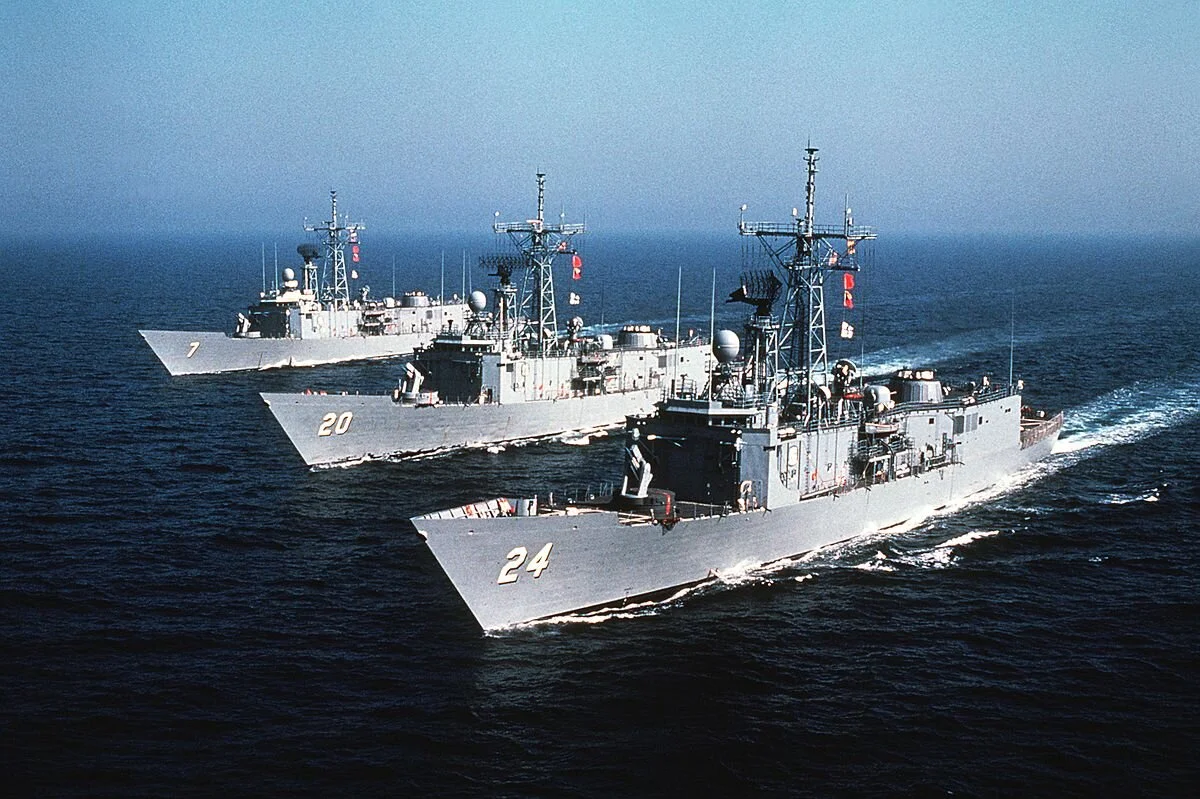
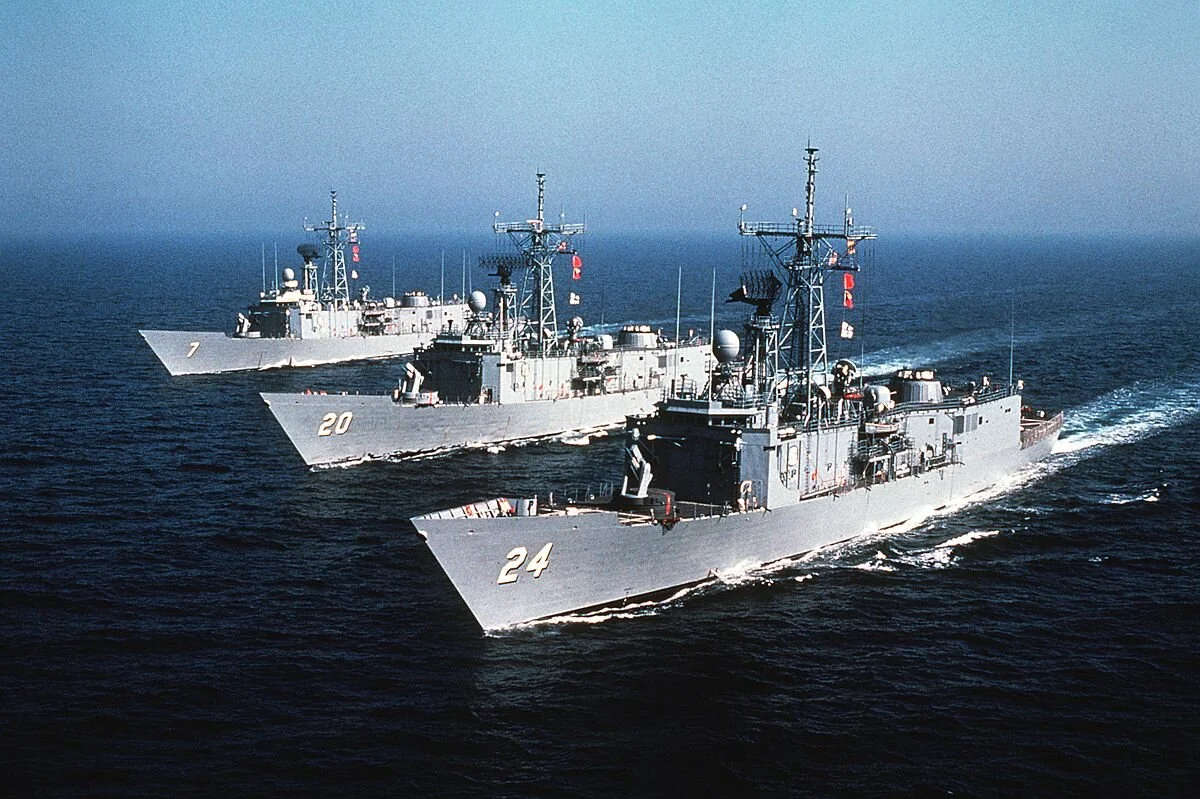
Long-term, the Navy must improve the rate it maintains and upgrades ships, or else it will never acquire a 355-ship fleet, Moore said. The Oliver Perry-class frigates were decommissioned mostly because their lethality waned, Moore said. Maintaining the ship hulls and mechanical equipment was possible. The ability of the frigates to provide

“It’s not because we didn’t know how to maintain the platforms. The reality was the combat systems became irrelevant,” Moore said. “I told the [Chief of Naval Operations Adm. Michael Gilday], as long as you’re confident that the combat systems are relevant, I can promise you the NAVSEA side of the house, the maintenance side of the house can keep that ship longer. I’m very confident to getting them to 45, 50 years.”

1200px-Oliver_Hazard_Perry-class_frigates_underway_in_1982.JPEG

Lawmakers Say New Budget Hurts Competition with China for Naval Power, Shipbuilding

By: Megan Eckstein

March 4, 2020 6:55 PM • Updated: March 4, 2020 7:52 PM

USNI.org

Sailors aboard Chinese missile destroyer Xi’an during the military parade marking Russia’s Navy Day on the sea near Kronshtadt islet off the shore of St. Petersburg, Russia on July 28, 2019. Xinhua Photo

China is not only a pacing threat to the U.S. naval fleet but also to the American shipbuilding industry and supply chain, Navy leaders and lawmakers said today during a Senate Armed Services seapower subcommittee hearing.

Navy acquisition chief James Geurts said during the hearing that “our pacing threat from China is their ability to scale and produce, leveraging their very strong marketplace.” The U.S. needed to bolster its own shipbuilding industrial base, too, to remain competitive and healthy enough to scale up as the Navy tries to grow its capacity to compete with China.

Lawmakers in the House and Senate worried the Navy was shooting itself in the foot in that respect, introducing instability to the shipbuilding industry at the very time the Navy should be strengthening it.

In a later hearing with the House Armed Services’ seapower and projection forces subcommittee, Geurts said the U.S. shipbuilding base and supply chain was in place today to get to 355 ships by 2030, but the money isn’t there to buy these ships and scale the fleet up alongside China’s.

Several congressmen on the committee took issue with this description of the industrial base, though, saying that the Navy is creating instability for industry by drastically changing its long-range plans from year to year. On the submarine side, previous long-range plans called for continued two-a-year production of Virginia-class submarines to keep industry stable as it tries to add in the Columbia-class ballistic missile submarine work too, but this year the FY 2021 budget request unexpectedly cut the second SSN to divert more funds to the National Nuclear Security Administration. And money in this current fiscal year meant to keep amphibious warship construction moving along smoothly has been redirected to pay for border wall construction. In both these cases, the decision to take money from shipbuilding programs was made at the Pentagon or administration level, not by the Navy.

“What we’re doing to our industrial base and our suppliers – and there’s no better example than with the Virginia-class submarine and delaying the submarine – is the fact that they want to invest, they want to build the ships, they want to hire and train the workforce, but we keep changing the plan,” Rep. Elaine Luria (D-Va.) said during the HASC hearing.
“And last year at these hearings I brought up the 30-year shipbuilding plan as an example. If the 30-year shipbuilding plan changes every single year in years one through three – not the end of it, 20 to 30 years from now when we could expect there’s change, but if it changes the immediate plan every year, how is it a plan? How can the industrial base plan for that?”

Despite the noticeable changes to the plan at the shipbuilder level, Geurts said his office was tracking industrial base health closely at the supplier level and looking for specific areas in need of support.

“I have hired a full-time supply chain expert, and we have created a whole supply chain set of expertise across all of our programs,” he said. China is, “also competing with us and against us in many of the supply chain areas, so supply chain integrity, really understanding that supply chain, what it costs, where we have fragility, where we have opportunity, is a critical thing we’ve really been focused on for the last two years or so. We’re starting to see that really add benefit.”

He said his office is paying particular attention to the nuclear shipbuilding industry, which builds components for the Ford-class aircraft carrier as well as the Virginia attack boats and the Columbia-class ballistic missile submarine.

Geurts said the carrier construction and refueling business at Huntington Ingalls Industries’ Newport News Industries employs about 10,000 people at the Virginia yard, but it also relies on 50,000 people at 2,000 suppliers in 46 states. A range of factors – including Chinese companies buying American suppliers – has contributed to fragility in the supply chain in some areas, with perhaps just one supplier who may not be able to keep up with the increasing nuclear shipbuilding workload or who may be especially sensitive to cuts in the budget, such as the second Virginia being taken out of the 2021 request.

Despite Geurts’ praise for the current health of the shipbuilding industry and his office’s attention to the health of the supply base, SASC seapower subcommittee chairman Sen. David Perdue (R-Ga.) said both aspects of this competition with China – the naval force and the industrial base – are being hurt by the Fiscal Year 2021 budget request, which cuts 10 ships from Navy construction plans over the next five years and hurts both industry and the fleet’s ability to grow as fast as needed.

“It appears to me that the Department of the Navy’s proposed budget is sufficient to support a fleet of about 300 ships. The budget proposal for fiscal years 2021 through 2025 does not keep pace with inflation, which means growing the Navy much at all, much less to the 355 ships we need to meet all the threats we face, is financially unrealistic,” Perdue said in his opening statement.
“I think it is time we rethink how we fund our Navy and shipbuilding enterprise. Today, we spend roughly $750 billion on our military. Each department of the military gets roughly one-third of what’s left after overhead. Our current National Defense Strategy is a maritime strategy, as former Secretary Mattis stated. I am skeptical that the current one-third funding level for the Department of the Navy is enough to meet that goal. If we are to remain the global leader above, on, and under the seas, we must get serious about building the fleet we need.”

Perdue went on to show a chart comparing China’s naval buildup compared to the U.S. Navy’s. The chart shows China surpassing 355 ships this year and reaching 425 by the end of the decade, in 2030. The U.S., on the other hand, has 296 today and hits 331 by the end of the decade. The U.S. Navy would reach 355 ships by 2034 under the FY 2020 budget request. An updated ship inventory projection based on cutbacks in shipbuilding and accelerated decommissionings of some ships proposed in the FY 2021 request hasn’t been made available yet due to the Pentagon delaying its release to run additional analysis.

“This year, there is no shipbuilding plan and the budget documents reflect a fleet size of about 306 ships. I would observe shipbuilding and fleet size trends, and therefore the Navy to some extent, seem to be going in reverse in this budget request, as compared to the Department’s previous plans,” he said.
“We are also hearing about ‘affordability’ and the ‘best balance of resources’ in hearings this year. I applaud the effort to adequately fund personnel, maintenance and other supporting functions. However, we cannot lose sight of the fact that the Navy must get bigger and we must find a way to pay for it. Because if we don’t, make no mistake, the Chinese will only accelerate the expansion of their maritime influence around the globe, creating fait accompli dilemmas at every turn, which come at the expense of U.S. interests and those of our partners and allies. The stakes are real.”

An EA-18G Growler, assigned to Air Test and Evaluation Squadron (VX) 23, prepares to take off from USS Gerald R. Ford’s (CVN-78) flight deck on Jan. 25, 2020. US Navy Photo

An EA-18G Growler, assigned to Air Test and Evaluation Squadron (VX) 23, prepares to take off from USS Gerald R. Ford’s (CVN-78) flight deck on Jan. 25, 2020. US Navy Photo

Graphic from Sen. David Perdue, Senate Armed Services seapower subcommittee chairman.

Graphic from Sen. David Perdue, Senate Armed Services seapower subcommittee chairman.

SECNAV Modly: Navy Needs Additional $120 Billion To Build 355-Ship Fleet By 2030

By: Ben Werner

February 27, 2020 5:36 PM • Updated: February 27, 2020 9:54 PM

USNI.org

Acting Secretary of the Navy Thomas B. Modly, center, receives a briefing on the aircraft carrier USS Gerald R. Ford (CVN-78) electromagnetic aircraft launch system (EMALS) on Jan. 31, 2020. US Navy Photo

The Navy could build a 355-ship fleet by 2030, but paying for such a force will require adding between $120 billion and $130 billion to the service’s funding over the next decade, Acting Secretary of the Navy Thomas Modly told lawmakers Thursday.

Assuming the Navy and Department of Defense receive flat topline budgets for the next decade, Modly estimates it will take between $12 billion and $13 billion in additional funding each year to pay for building, staffing, maintaining and sustaining a 355-ship fleet.

At the current funding level – a proposed $20-billion shipbuilding budget in Fiscal Year 2021 – Modly said, “we’re kind of tapping out at about 305 ships; that flatline can sustain that 305 ships.”

The Navy is conducting a Stem to Stern review to scour its budget for ways to cut spending on programs or staffing that are redundant or don’t fit with the core mission, and to apply these savings to shipbuilding, Modly said. The goal is to find about $8 billion in savings a year for the next five years, which will help but not entirely solve what he sees as a fundamental funding problem.

“I think ultimately we can dig deep and find something, but there’s going to have to be a broader discussion about a higher topline for the Navy,” Modly said.

Modly had previously told USNI News that realizing internal cost savings was an important first step before ultimately asking the Pentagon to increase its topline.

“I am completely convinced that there’s money within our budget that could be spent a lot more efficiently – I’m talking about just the Navy budget – and we have to do the work to do that before we can convince anybody else above us to give us more in our topline,” he said.

Despite Modly’s optimism about accelerating the Navy’s shipbuilding rate, lawmakers were not convinced his plan was achievable. Several members of the panel pointed out the service has yet to release an updated 30-year shipbuilding plan based on the FY 2021 proposal.

As of now, all lawmakers have to reference is the five-year shipbuilding plan in the FY 2021 budget request, which includes cutting three ships from production and retiring four cruisers, four Littoral Combat Ships and three amphibious warships. In FY 2021, the Navy’s entire shipbuilding budget drops to $20 billion, a $4 billion decrease from what lawmakers approved for FY 2020.

“As I look at the numbers, the shipbuilding account is down about $4 billion from last year and the readiness, the [operations and maintenance] account for the Navy is up about $3.6 billion from last year,” Rep. Mac Thornberry (R-Texas), the top Republican on the committee, said in the hearing.

If the Navy’s emphasis is finding ways to fund expanding the fleet, Thornberry wanted to know why the FY 2021 request shifts money away from shipbuilding to pay for maintenance.

“It’s an intentional trade because our decision was at this particular time, because of the readiness hole we had fallen into over many, many, years, we had to address that,” Modly said. “That immediately impacts the safety and security of sailors and Marines on those platforms. We could not in good conscious trade that money for more ships if they could not operate properly.”

Several lawmakers were concerned with being asked to support a FY 2021 budget request that decreases the Navy’s shipbuilding budget without the benefit of seeing the Navy’s long-term shipbuilding strategy.

“It’s hard for us to give you money until we know your vision,” said Rep. Mike Gallagher (R-Wisc.).

Rep. Elaine Luria, (D-Va.) questioned the push for 355 ships considering it’s based on the Optimized Fleet Response Plan (OFRP). But the OFRP suggests the Navy doesn’t really need 355 ships, she said.

As designed, the OFRP is a 36-month cycle built around maintenance and training for a seven-month deployment of a carrier strike group. The cycle also includes a sustainment period when a ship or strike group could redeploy or surge forward on short notice.

According to the OFRP, Luria said, ships should be deploying six out of every 36 months, or 17 percent of the time. The Navy instituted the OFRP to give crews more time to perform training and maintenance. Previously, ships deployed six out of every 24 months, or 25 percent of the time, she said.

“I’m not that smart with math, but I am a Navy nuke, and I can do the math backwards, and 355, if you do the math backwards, at 25 percent of the time you only need 282 ships to do the same thing presence-wise before you went down in the amount of time you are deployed,” Luria said. “So honestly, a force structure assessment and a 30-year shipbuilding plan that are based off of an assumption we’re only going to deploy 17 percent of the time, six or seven out of 36 months it doesn’t work.”

Modly pushed back, saying the Navy can have a 355-ship fleet by 2030.

“I think this is possible, and I mention it in the plan,” Modly said.

“So, it’s possible in the plan that we haven’t seen yet?” Luria asked. “It tells us how to get to 355 in a decade?”

Following up on Luria’s question, Smith advised Modly to focus less on a number and more on the capabilities of the future fleet.

“In the end, this budget submission is the manifestation of the hard choices we had to make this year,” Modly said.
“While this budget does slow our trajectory to a force of 355 ships or more, it does not arrest it. You can have my personal assurance we are still committed to building that larger, more capable, more distributed naval force within what I consider a strategically relevant timeframe of no more than 10 years.”

170603-N-PD309-648.jpg

SECDEF Esper Blames Failures of Optimized Fleet Response Plan for Delay of New 355-Ship Fleet Outlook

By: Ben Werner

February 26, 2020 9:51 PM

USNI.org

The island of the aircraft carrier USS John F. Kennedy (CVN 79) is landed onto the flight deck during a mast-stepping ceremony at Huntington Ingalls Industries Newport News Shipbuilding in Newport News, Va., May 29, 2019. Navy photo courtesy HHI by Matt Hildreth/Released

Ongoing problems with the Navy’s Optimized Fleet Response Plan delayed the release of the service’s new force structure assessment and long-term shipbuilding plan, Secretary of Defense Mark Esper told the House Armed Services Committee on Wednesday.

Esper told the panel a briefing with Navy leaders last Friday gave him doubts the pending Integrated Force Structure Assessment (IFSA) was ready for release. Since the conclusions of the new IFSA is an integral part of the long-range shipbuilding plan, Esper said he also held that report as well.

“There are some questions with regard to IFSA that I have, that I’m concerned about,” Esper said. “An assumption in the IFSA is that the OFRP works. The OFRP hasn’t worked for years, so why should we assume it will work in the future.”

USNI News first reported on the delay in releasing the long-range shipbuilding plans and the Friday meeting between Esper and Navy leaders.

As designed, the OFRP is a 36-month cycle built around maintenance and training for a seven-month deployment of a carrier strike group. The cycle also includes a sustainment period when a ship or strike group could redeploy or surge forward on short notice.

While the plan promised more reliability in how ships deployed, the Navy has been unable to meet its maintenance or readiness targets set out by the plan. The Navy started evaluating the effectiveness of OFRP last summer to see if the system needed changing, Adm. Christopher Grady, the commander of U.S. Fleet Forces Command, said in January at the Surface Navy Association 2020 symposium.

Acting Secretary of the Navy Thomas Modly described the IFSA as including changes to the way Navy traditionally considered manning while speaking last Friday at a Center for Strategic and International Studies event with the other service secretaries. At CSIS, Modly said the IFSA would be released within days.

Previously, Modly and Chief of Naval Operations Adm. Mike Gilday have both said the new IFSA calls for at least 355 manned ships and new classes of unmanned vessels. Both are scheduled to appear before HASC on Thursday.

However, the Navy presented a flat Fiscal Year 2021 shipbuilding budget request critics say barely provides enough funding to maintain a fleet of 300 ships. The five-year outlook in the FY 2021 budget proposed constructing 13 fewer ships than the Navy projected a year ago in its FY 2020 budget, according to a Congressional Research Service report released last week on Navy Force Structure.

On Monday, Esper decided to hold onto the IFSA and the required 30-year shipbuilding plan until a series of reviews are completed by the Navy, outside think tanks, and members of the Pentagon’s Cost Assessment and Program Evaluation (CAPE), Esper said. He plans to incorporate the combined findings of these three reviews into the IFSA and shipbuilding plan.

“So, there are assumptions I want to go back and have discussions with the Navy,” Esper said. “There’s other assumptions in there about ships and warfighting, that I want to make sure I get right, so when I present you the plan, it’s defensible and I feel confident in it and the Chairman feels confident in it.”

1200px-Oliver_Hazard_Perry-class_frigates_underway_in_1982.JPEG

SECDEF Esper Faced Bipartisan Criticism Over ‘Anemic’ Shipbuilding Plan

By: Ben Werner

February 26, 2020 6:55 PM

USNI.org

Secretary of Defense Dr. Mark T. Esper is briefed on USS Gerald R. Ford’s (CVN 78) advanced weapons elevators (AWE) by Capt. John J. Cummings, Ford’s commanding officer. Navy photo

Secretary of Defense Mark Esper faced sustained bipartisan criticism from the House Armed Services Committee over the Pentagon’s proposed shipbuilding plan during a Wednesday hearing on the Fiscal Year 2021 Pentagon budget.

Republican and Democratic committee members asked Esper how his request to buy eight ships in the upcoming fiscal year moves the Navy closer to fielding a 355-ship fleet.

Of the eight ships requested in the FY 2021 budget, one – LPD-31 – was authorized last year, so there’s only seven ship buys requested, said Rep. Joe Courtney (D-Conn.).

“Two of those seven are tugboats. They are salvage ships,” Courtney said. “We are not getting briefings in this committee about Russian tugboats or Chinese tugboats.”

The FY 2021 budget request also cuts funding for a Virginia-class fast-attack submarine at the same time the Navy plans to retire submarines quicker than new ones join the fleet, Courtney said. The Navy has been buying two fast attack submarines a year and has considered buying three in some years.

“For the record, we are at 52 attack submarines today. With the retirement of Los Angeles-class attack submarines, which are going to accelerate over the next four or five years, that fleet is going to shrink 44 subs,” Courtney said. “Your budget keeps us in that trough into the 2030s.”

The budget request proposes adding $2.5 billion to the National Nuclear Security Administration (NNSA). Yet, the organization currently has about $8 billion in unspent funding from the FY 2020 budget, said Rep. Adam Smith, (D-Wash.), the HASC chairman.

Gen. Mark Milley, who joined Esper at HASC on Wednesday, was asked by Rep. Susan Davis (D-Calif.), “is it in your best military advice that cutting a Virginia-class submarine to increase the NNSA’s budget by 20 percent is good prioritization?”

“No, it is not, ma’am,” Milley responded. “In that particular case, I wasn’t personally involved in the decision on that. However, that was a case where there were some internal deliberations at the last minute to make sure the nuclear enterprise was fully funded. So, it’s a question. I wasn’t personally in the meeting on that one. However, had I been, I would have supported the fully funding of the nuclear enterprise.”

Money for the second Virginia-class submarine in FY 2021 tops the Navy’s unfunded priorities list. Still, Courtney said the Pentagon hadn’t put forward such an “anemic shipbuilding request” since the height of the surge to send more troops to the Middle East more than a decade ago. The request, “defies any analysis in terms of something that comports with the National Defense Strategy, based on the activities that we are seeing from China and Russia.”

When factoring in the number of impending ships decommissioning, Rep. Rob Wittman (R-Va.) asked how the plan moves the Navy forward in terms of fleet size and reflecting the need for the Navy to project power and deter conflict.

“We’re decommissioning four LCS’s, four cruisers, and three amphibious ships,” Wittman said. “I’m not very good at math, but that math doesn’t add up to me to get to 355. In fact, we’re heading south on that.”

Esper agreed the FY 2021 budget plan falls short of expanding the fleet, but for what he said was a good reasons.

“We need to get on a better trajectory for 355-plus. That’s why… we need that three to five percent real growth,” Esper said, referring to his request for defense spending to increase at or above the annual rate of inflation. “I do support the Navy’s decision to reallocate dollars to readiness, because of the challenge we’ve had getting ships to sea and operationally available.”

Flat budgets, such as this year’s request of $740 billion, which is just slightly above the FY 2020 budget, are what the Pentagon should expect, Smith said. He suggested Esper should consider how the Pentagon can fulfill its National Defense Strategy mandate.

“It’s highly unlikely that we’re going to hit that three to five percent number so it might be appropriate to rethink aspects of the NDS and see what makes sense, in keeping with the overall theme that our means match our desired ends,” Smith said.

The problem, Courtney said, is the Navy and shipbuilding industry doesn’t quickly recover from the cuts proposed in the FY 2021 budget. The five-year shipbuilding proposed in the FY 2021 budget, Courtney said, “Is a cut from the Obama projection in terms of fleet size and keeps us further away from trying to get to the goal of the 350 ship Navy.”

HASC members from both parties were also not pleased with how Esper moved money from the FY 2020 budget to the Department of Homeland Security to pay for border barrier construction.

Rep. Mac Thornberry (R-Texas), HASC’s ranking member, said he supports border security but did not like the way the administration moved money from the defense budget to pay for what is a Department of Homeland Security program.

“We are about to embark on trying to write a defense authorization bill… and I guess my basic question to you is: Is it going to matter?” Thornberry asked. “Or, will [the Office of Management and Budget] send down a directive saying… to take away some money for some planes, or satellites or something and move it to other things?”

Esper said, “What the Congress does matters, matters very much and we look to the Congress as partners as we try to develop our game plan to serve the country, defend the country and help us implement the NDS.”

fin_FREMM-592-2.jpg

SECDEF Esper Holds Back 30-Year Shipbuilding Outlook, New 355-Ship Plan Ahead of HASC Testimony

By: Sam LaGrone

February 25, 2020 1:23 PM

USNI.org

Secretary of Defense Mark Esper delivers a speech to students and faculty of the U.S. Naval War College on Aug. 27, 2019. US Navy Photo

Release of the Navy’s long-range shipbuilding plan and service’s plan to grow to at least 355 ships is on indefinite hold on orders from Secretary of Defense Mark Esper, USNI News has learned.

Four sources familiar with the move told USNI News that following a Friday meeting between Navy officials and Esper, the Defense Secretary ordered to hold the release to Congress of the legally required long-range shipbuilding plan and the latest force structure assessment.

Esper and Navy leaders are set to testify this week before the House Armed Services Committee on the Pentagon and Department of the Navy budget requests, respectively, before members have seen either the long-range shipbuilding plan or the FSA, several legislative sources confirmed to USNI News.

The decision from Esper was made on Monday while the Navy was set to sign out the latest force structure assessment that would chart the service’s path to build at least a 355-ship Navy. The increase in hulls was a key national security promise President Donald Trump made during his 2016 campaign. As of Monday, the Navy had 295 ships.

Acting Secretary of the Navy Thomas Modly and Chief of Naval Operations Adm. Mike Gilday have both said the new FSA would call for at least 355 manned ships in addition to new classes of unmanned vessels.

An Office of the Secretary of Defense spokesperson acknowledged a request for comment by USNI News on Tuesday but did not immediately provide a statement.

Navy officials did not immediately return a USNI News request for comment.

Though there is a requirement in law to deliver the long-range shipbuilding plan with the budget to Congress, the final version has often delivered days or weeks after the intial budget submission. There is no legal requirement to present the FSA to Congress, USNI News understands. A defense official told USNI News on Tuesday delivery of the plan to Congress was pending.

While both Esper and Navy leadership have committed to the 355 goal, the service presented a flat budget shipbuilding budget request for Fiscal Year 2021 that critics have said would barely give the Navy the funds to maintain a 300-ship fleet, much less grow by almost 60 hulls.

“It’s impossible to square this plan with the administration’s National Defense Strategy and its claim that it supports a 355-ship fleet,” House Armed Services seapower and projection forces subcommittee chairman Rep. Joe Courtney (D-Conn.) said when the budget request was released earlier this month.
“At $19.9 billion, this request is nearly 17 percent lower than current funding levels and truthfully proposes just six combatant vessels – the lowest level in a decade.”

Anticipating the flat budget, Sen. Roger Wicker (R-Miss.) released legislation this year to help fund the Navy’s shipbuilding accounts to help get to the 355 ship goal.

“In the near term, the Securing the Homeland by Increasing our Power on the Seas (SHIPS) Implementation Actwould empower our Navy to reach its 355-ship goal by authorizing the procurement of specific vessels and cutting costs. Over time, my proposal would help to decrease risk for the Navy and provide greater certainty for the industrial base,” he said in a release.

With the FY 2021 budget, the Navy delivered a five-year outlook that called for the construction of 13 fewer ships than it had projected in its FY 2020 budget, according to a Congressional Research Service report released last week on Navy Force Structure. The Navy is struggling not only to fund new iron but to clear an ever-growing backlog of maintenance and readiness problems it accrued during its supporting role for the wars in Iraq and Afghanistan.

The Navy’s head budget officer told reporters earlier this month that the service was trying to balance top acquisition priorities of the Columbia-class ballistic missile submarine with the ongoing readiness issues and the White House requirements for new ships.

“We have a flat topline and we’re trying to fund Columbia class, which is our highest priority. Columbia is going to result in consuming over 20 percent of our SCN (shipbuilding) account as we get towards the end of the [five-year Future Years Defense Program], and as we get to serial production (in 2026) it will be over 30 percent. So I think that’s part of the issue, trying to address that inside of the Navy budget,” Rear Adm. Randy Crites, the deputy assistant secretary of the Navy for budget. said on Feb. 10.

“It’s what we can afford,” he said.
“We can’t hollow out the force, we have to continue with the vector we’re on to recover our readiness. … At the end of the day, with a flat topline that’s not even keeping up with inflation, and much more complex ships that we’re bringing on – they’re more expensive and they’re more expensive to maintain … capable capacity … is what we’re going to be able to afford.”

For his part, Esper has said the Navy will have to figure out how to handle the Columbia-class program.

“Clearly the Columbia is a big bill, but it’s a big bill we have to pay,” he told Defense News. “That’s the Navy’s bill. The Air Force has a bill called bombers and ground-based strategic deterrent, so that’s a bill they have to pay.”

For its part, the Navy announced a new cost savings drive to find $40 billion in budget savings to pay for the new fleet.

“We must find savings within the Department to reinvest in the kind of decisive naval force that will provide for our nation’s future economic and political security,” Modly wrote last week.
“The bottom line is that we need to find at least $40 billion in real line-of-accounting savings to fund the development, construction, and sustainment of this new fleet over the next 5 years, and to set the Department up for continuing this trajectory in the 5 years that follow.”

ffgx_2_med.jpg

Budget Analysis and the U.S. Navy's Future Fleet Design

BY CIMSEC 02-21-2020 03:05:00 

[By Dmitry Filipoff]

Capt. Arthur “Trip” Barber (ret.) served in the Navy for 41 years, ultimately capping his career in the civilian Senior Executive Service as the Navy’s Chief Analyst for the last 12 of those years. In this wide-ranging and candid conversation, Barber discusses major challenges with ongoing force structure assessments, how he helped lead the Navy’s Assessment Division (N81) in shaping the budget, and what it will take for the Navy to make some of its most ambitious warfighting concepts a reality. 

The Navy is at an inflection point as it conducts force structure assessments to determine what the future fleet may look like, including along the lines of an integrated force that more closely involves the Marines. How do you view the challenges of force structure assessment and fleet design in this modern age of rapid change?

Force structure assessments should be based on some form of analysis of steady-state and wartime capability requirements that uses specific types of units to meet these requirements, and that uses a specific set of military objectives to be achieved, and a concept of operations for the units’ employment against specific threats when doing so. If the design of the force is stable and the characteristics and employment concepts of its units are mature, this is a pretty straightforward task. That is not where the Navy is today.

When major changes in unit characteristics and force employment concepts are underway but have not yet stabilized and the threat is evolving rapidly, the task of doing a force structure assessment that produces specific provable numbers as the “requirement” for each type of unit becomes an unbounded problem. That is the situation the Navy is in today. It does not help that the whole process has become politicized and that the Navy is operating with a force structure requirement number that is unaffordable with current ship types, but is being told that the number must be achieved anyway, and soon. Force structure assessments are actually a set of about ten separate assessments of the requirements for that many different specific types of ships, so the aggregate number of 355 or whatever is misleading. If a requirement for 62 submarines is part of the 355 and the Navy has 42, but has 20 extra ships of some other type above the requirement for that type, the aggregate fleet number may be 355 but it is not the right fleet. That nuance is lost in the political process.

Until the new types of units and concepts of operations for these units are decided upon that will best meet our projected warfare challenges, including the newest one of operating as an “integrated” force with the Marines as they implement their new Commandant’s brilliant and disruptive force-planning guidance, it would be nice if the Navy could stop throwing force structure assessment numbers around. It would be ideal, although probably politically unrealistic, to take a pause in such assessments while a whole new design for the future fleet is worked out in detail. This could and should have been done over the last three years since the last force structure assessment, but it was not because the amount of change required was simply too disruptive for the institutional Navy to handle at that time. I think it is underway now, finally, but it will take a couple of years to settle out to the point where a force structure assessment is meaningful.

The Navy is looking to move toward a Distributed Maritime Operations concept for how it employs its forces. What do you make of this warfighting concept, and what could it take the Navy to get there?

Operating as an aggregated and concentrated force against an adversary like China with a massive long-range precision reconnaissance-strike system is not a survivable concept. Distributing the force is essential, but the distributed units need to be able to support each other and concentrate their effects when and where necessary. This requires a significant degree of connectivity and data movement between units at beyond-line-of-sight ranges, in an environment where the adversary is attacking that networking capability as their principal line of military effort. If a distributed force is not connected, it will be defeated in detail.

The concept for executing this connectivity is the “naval tactical grid” or whatever the equivalent joint term of the moment may be. It means everybody can communicate what they need to, when they need to. This aspiration began with Vice Admiral Art Cebrowski’s FORCEnet concept in the 1990s, but it has not made the implementation progress that it should have. Engineering this without ripping out every radio on every unit and starting over is really hard technically, and expensive. Nobody wants to own and pay this bill. Enforcing conformance of all systems and units to common and truly interoperable data and communications protocols is very difficult organizationally. But until we do both, distributed operations will not work very well. Achieving this connectivity vision is as disruptive a change as changing the design of the units that make up the fleet, and this is another change that I do not think is going on at the pace that is appropriate to the strategic situation we are in.

In recent years the OPNAV staff saw some restructuring that sought to give the strategists a greater ability to provide inputs into developing the budget. How do you see the evolving relationship between strategy inputs and the Program Objective Memorandum (POM) process?

“Strategy” is the purview of the Chairman of the Joint Chiefs and the Secretary of Defense, not the individual services. What the services call “strategy” and own is the concepts of force employment that they plan to use in execution of the strategy. The Navy’s strategic expression that counts is the budget it builds that funds and delivers specific forces and capabilities. That determines what the Navy can do, and more importantly what it cannot do. Navy strategists have generally been unable to articulate timely guidance that made strategic choices about what to not do in order to focus the available resources on the most critical things that must be done. When resources are constrained, you cannot have one without the other. Their guidance said everything was important, few things could be cut, and it usually came out late, so far into the POM-development timeline that funding decisions had already been made. Time, tides, and POMs wait for no man.

Unfortunately, the current political imperatives of sustaining and even increasing force structure size without a corresponding top line increase have limited the effect of strategic focus and analysis on what actually gets funded in the POM.

There is debate on how well wargaming has been employed to inform decision-making, particularly with respect to analytic rigor and ownership. How could wargaming evolve to have greater analytic clout within DoD?

Wargaming can have a distinct and important role in shaping the Navy’s direction, particularly in times of disruptive and rapid technological change, such as we are now in. If wargames are structured in a disciplined manner with realistic assumptions about event timing, logistic feasibility, threat behavior, and technology; are focused on the most critical issues; and have the right participants, they can be very useful. They can provide insights about which courses of action, technologies and concepts of employment are promising, and which are unlikely to work in a specific scenario. Wargames are human-in-the-loop activities whose outcomes change with each set of humans that do them, they are not rigorous repeatable analysis. Their best role is to shape the assumptions that are used by quantitative analysis before that analysis is applied against new operational problems. This analysis should then ideally be tested through operational experimentation that puts hardware (real or virtual) in the loop to see if things work out the way as predicted.

This “virtuous cycle” of wargame-analyze-experiment is the ideal way to design a force, but each step of this cycle is today owned and operated by a different organization, and it is fairly rare that the full cycle is actually executed in a coherent, end-to-end manner on a specific operational challenge. It takes time, focus, and patience to achieve this end-to-end coherence, and with organizational leadership rotations being what they are in the U.S. military, this is hard to do. There are a few areas where this happens fairly well, such as in air and missile defense, but the Joint and Navy future-force planning processes could and should do this more broadly and better.

Arthur H. (Trip) Barber is a retired Navy Senior Executive Service civilian, a retired Navy Surface Warfare Captain, and an engineering graduate of MIT and the Naval Postgraduate School. He was the Navy’s chief analyst of future force structure and capability requirements on the OPNAV staff as a civilian from 2002 to 2014.

Dmitry Filipoff is CIMSEC’s Director of Online Content. 

This article appears courtesy of CIMSEC and is reproduced here in an abbreviated form. The original may be found here. 

The opinions expressed herein are the author's and not necessarily those of The Maritime Executive.

tripoli_launch_navy-2.jpg